Achieving Precision with the Milk Carton Clay Cutter: Edge Profiles and Sizing Guide
The resurgence of polymer clay and ceramic arts has driven a demand for tools that bridge the gap between handmade charm and manufacturing precision. Among these essential implements, the Milk Carton Clay Cutter stands out as a versatile staple for artisans creating miniature food, jewelry components, and decorative charms. Unlike generic circular cutters, this specific profile offers a distinct aesthetic that mimics classic dairy packaging, making it indispensable for creators focusing on retro themes, kawaii aesthetics, or realistic culinary miniatures. However, selecting the right cutter involves more than just picking a shape; it requires understanding the nuanced relationship between blade geometry, material thickness, and the capabilities of your production equipment.
Distinguishing Between Normal and Sharp Edge Geometries
One of the most critical decisions when acquiring a Milk Carton Clay Cutter is choosing between the two available edge profiles. This distinction is not merely about sharpness but fundamentally alters how the tool interacts with the clay body and influences the finishing workflow. Manufacturers typically provide both normal and sharp options to accommodate different clay densities and artistic preferences.
The Normal Edge Profile
The Normal Edge cutter is engineered for durability and ease of handling. Featuring a 0.7mm wall thickness paired with a robust 3mm base, this variant prioritizes structural integrity over razor-thin slicing. The wider base provides a comfortable surface area for your thumb or palm, reducing hand fatigue during repetitive cutting sessions. This geometry is particularly advantageous when working with firmer clays or when the cutter will be subjected to significant downward pressure.
Because the 0.7mm wall displaces more material, cuts made with the Normal Edge may require slightly more cleanup to achieve a perfectly crisp silhouette. However, this trade-off results in a tool that is less prone to bending or warping over time. For beginners or those working with children in educational settings, the Normal Edge offers a safer, more forgiving introduction to clay shaping without sacrificing the iconic milk carton form factor.
The Sharp Edge Advantage
For professional finishers and detail-oriented artists, the Sharp Edge Milk Carton Clay Cutter represents the pinnacle of clean extraction. This profile utilizes a specialized dual-wall construction: a cutting blade with a mere 0.4mm wall supported by a 0.7mm support wall. This hybrid design allows the tool to slice through conditioned polymer clay or soft porcelain with minimal resistance while maintaining enough rigidity to prevent the blade from collapsing under pressure.
The reduced friction of the 0.4mm blade means less drag on the clay surface, resulting in edges that often require little to no sanding. This is vital when creating translucent clay pieces where edge distortion can ruin the optical clarity, or when working with delicate millefiori canes where compression could distort the internal pattern. While the Sharp Edge demands a lighter touch and more careful storage to protect the fine blade, the reduction in post-processing time makes it a superior choice for high-volume production or competition-grade work.
Navigating Size Variations for Project Scalability
Versatility in scale is what transforms a single tool into a comprehensive system. The Milk Carton Clay Cutter is available in an extensive range of sizes to suit everything from 1:12 scale dollhouse miniatures to statement jewelry pendants. Understanding how these sizes are measured ensures you select the correct dimensions for your specific application.
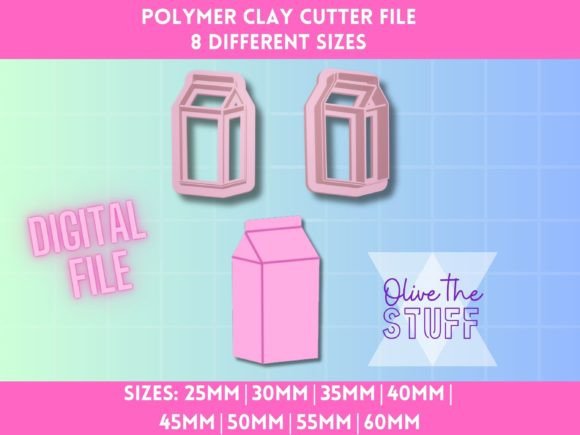
It is important to note that the stated size always refers to the widest part of the clay cutter. In the case of sets or complex shapes like the milk carton, this measurement encompasses the broadest point of the profile rather than an average diameter. Available increments include:
- 25mm and 30mm: Ideal for intricate dollhouse groceries, charm bracelets, and nail art embellishments.
- 35mm and 40mm: The standard range for earrings, keychains, and general-purpose miniatures.
- 45mm and 50mm: Perfect for larger pendant bases, ornament centers, and detailed sculptural elements.
- 55mm and 60mm: Suited for bold statement pieces, large-scale dioramas, or cookie-cutting applications with softer doughs.
Having access to this granular sizing spectrum allows artists to create cohesive collections. For instance, a creator might use the 60mm cutter for a main pendant piece and the 25mm version for matching stud earrings, ensuring visual consistency across a product line. When planning a project, always account for clay shrinkage rates, especially with ceramic materials, and verify whether the listed dimension accounts for this factor or represents the raw tool size.
Integrating Cutters into Modern Maker Workflows
The utility of the Milk Carton Clay Cutter extends beyond simple shape formation. In modern crafting workflows, these tools serve as jigs for consistency. When producing inventory for craft fairs or online shops, uniformity is key to perceived quality. Using a calibrated cutter eliminates the variability inherent in freehand cutting, ensuring that every milk carton charm in a batch of fifty is identical in footprint.
Furthermore, these cutters facilitate efficient material usage. The precise boundaries allow artists to nest cuts closely together on a clay slab, minimizing waste. For expensive metallic or translucent clays, this efficiency directly impacts profitability. The rigid walls also function as guides for texture stamps or silicone molds, helping to align surface designs perfectly within the carton silhouette before the clay is even removed from the work surface.
Critical Considerations for 3D Printing and Material Limits
Many artisans now produce their own tools using FDM or resin printers, and the Milk Carton Clay Cutter is a popular file for fabrication. However, successful printing requires respecting physical limitations. Before purchasing digital files or attempting to print these cutters, you must honestly assess your printer’s capabilities.
The Sharp Edge variant, with its 0.4mm blade wall, pushes the limits of many standard FDM printers with 0.4mm nozzles. While theoretically possible, printing such thin walls often leads to layer adhesion issues or nozzle clogging if flow rates aren't perfectly calibrated. Resin printers generally handle these fine details better, but resin brittleness can be a concern for the Normal Edge's 3mm base if dropped. Always consult your printer’s manufacturer specifications regarding minimum wall thickness and feature resolution.
If you are purchasing pre-printed cutters, verify the manufacturing method. A Sharp Edge cutter produced on a poorly tuned printer may have rough layer lines that tear clay rather than slice it. Conversely, a well-tuned Normal Edge cutter from a reliable source may outperform a poorly printed Sharp Edge. Understanding these technical constraints prevents frustration and ensures that the tool performs as intended in your studio environment.
Maintenance and Longevity Best Practices
Regardless of the edge type chosen, proper care extends the functional life of a Milk Carton Clay Cutter. Polymer clay contains plasticizers that can degrade certain plastics over time, so wiping tools clean immediately after use is non-negotiable. For the Sharp Edge models, avoid using metal needles or blades to remove stuck clay, as this can nick the delicate 0.4mm cutting edge. Instead, use a soft brush or compressed air.
Storage also plays a role in preservation. Keep Sharp Edge cutters in protective cases or padded rolls to prevent the fine blades from being crushed against harder objects. The Normal Edge cutters are more resilient but should still be kept away from direct heat sources that could warp the 3mm base. By treating these precision instruments with respect, artists ensure consistent performance across thousands of cuts, making the Milk Carton Clay Cutter a reliable partner in creative expression.