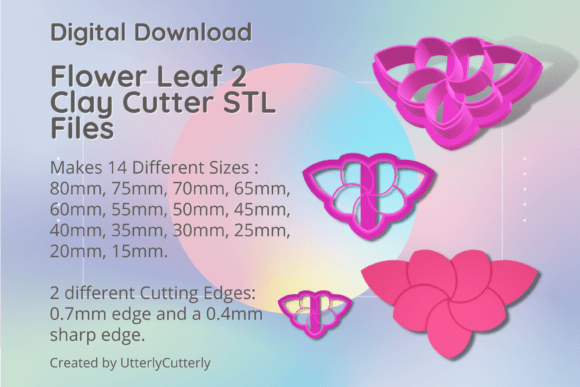
Flower Leaf 2 Clay Cutter STL Digital: Evaluation and Specifications
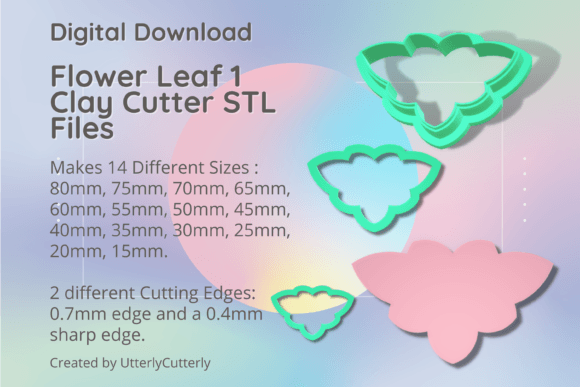
The Flower Leaf 2 Clay Cutter - STL Digital is a downloadable 3D printing file package designed for creators working with polymer clay, ceramic clay, and cookie dough. Unlike physical tools shipped by mail, this product provides the digital geometry required to manufacture your own cutting tools on-demand. The bundle specifically focuses on organic floral shapes suitable for jewelry making and culinary arts, offering a comprehensive size gradient and two distinct blade profiles. For makers evaluating whether to add this asset to their digital library, understanding the technical specifications, material compatibility, and practical applications is essential for determining if it aligns with current production needs.
Technical Specifications and Printability
A primary consideration when acquiring STL files for functional tools is print success rate and dimensional accuracy. The Flower Leaf 2 Clay Cutter - STL Digital is engineered with specific tolerances to ensure reliability across different FDM (Fused Deposition Modeling) printer setups. The pack includes 14 distinct sizes ranging from 15mm to 80mm, measured from the longest ends of the design. This granular sizing allows for precise scaling in multi-component projects without requiring manual resizing in CAD software, which can sometimes distort organic curves.
The bundle offers two specific cutter variations to address different material viscosities and finishing requirements:
- Standard Edge: Features a 0.7mm wall thickness with a 3mm thick base and a total height of 12mm. This profile provides structural rigidity, making it less prone to warping during printing or bending during use with stiffer clays.
- Sharp Edge (SE): Abbreviated as SE in the file names, this variation utilizes a 1mm support wall tapering to a 0.4mm cutting edge. It shares the same 3mm base and 12mm height as the standard version but is optimized for cleaner cuts in softer materials or detailed polymer clay work where drag marks are a concern.
Users should note that any embossing lines included in the design are set at 10.5mm tall. Consequently, these cutters are functionally limited to clay slabs thicker than 1.5mm to ensure the embossed detail registers correctly without bottoming out.
Applications in Jewelry and Culinary Arts
The versatility of the Flower Leaf 2 Clay Cutter - STL Digital lies in its dual-purpose geometry. While primarily marketed toward jewelry makers, the food-safe nature of PLA and PETG filaments (when printed correctly) extends its utility to baking. For jewelry artists, the size range supports a wide array of accessories. The smaller increments (15mm–30mm) are ideal for earring charms and delicate pendant layering, while the larger sizes (60mm–80mm) accommodate statement brooches, hair barrettes, and bold necklace components.
In culinary contexts, the Sharp Edge variant is particularly relevant. Cookie dough requires a clean shear to maintain shape definition during baking. The 0.4mm edge reduces friction compared to standard blades, helping to preserve intricate leaf veining details that might otherwise smear. However, users must verify filament safety and post-processing hygiene before using these printed tools with consumables, as layer lines can harbor bacteria.
Evaluating Fit: When This Bundle Is Appropriate
Digital fabrication assets offer distinct advantages over traditional manufacturing, but they are not universally superior. The Flower Leaf 2 Clay Cutter - STL Digital represents a strong fit for specific user profiles:
- High-Volume Prototypers: Makers who frequently test new designs benefit from the ability to iterate instantly. If a 40mm cutter proves too large for a specific earring hook, a 35mm version can be printed within minutes rather than waiting for shipping.
- Custom Tool Fabricators: Artists who require non-standard sizes will find value in the 14-size gradient. Commercial metal cutters typically come in fixed, limited sets; this digital bundle fills the gaps between standard industry sizes.
- Multi-Media Creators: Those working across both polymer clay and ceramics benefit from having both Standard and Sharp Edge profiles available in a single purchase, eliminating the need to source separate toolsets for different material densities.
- Geographically Remote Makers: For creators in areas with limited access to specialized craft supplies, digital downloads eliminate logistical barriers and import costs associated with physical tools.
Tradeoffs and Considerations
While digital files offer flexibility, prospective buyers must weigh several tradeoffs against purchasing pre-manufactured metal or plastic cutters. Understanding these limitations prevents misalignment between expectation and reality.
Equipment Dependency and Skill Floor
This product is strictly digital. Ownership requires access to a functioning 3D printer and proficiency in slicing software. Users unfamiliar with bed leveling, nozzle calibration, or support removal may experience failed prints or poor surface finishes. Metal cutters arrive ready-to-use; STL files require labor and material investment before becoming functional tools.
Durability and Material Limitations
3D printed plastic cutters do not possess the longevity of stainless steel. Over time, exposure to certain clay conditioners, oils, or abrasive ceramic compounds may degrade the cutting edge or cause layer separation. The 0.4mm Sharp Edge variant, while precise, is inherently more fragile than the 0.7mm Standard version. Users working with extremely stiff or dense clays may find the plastic edges deform faster than anticipated, necessitating frequent reprints.
Post-Processing Requirements
FDM printing naturally produces layer lines. Without sanding, coating, or chemical smoothing, these lines can transfer texture onto clay surfaces unintentionally. While the 3mm base provides stability, achieving a mirror-smooth finish on the cutting face often requires additional post-processing time that is unnecessary with injection-molded alternatives.
Making the Decision: Digital vs. Physical Alternatives
Selecting the Flower Leaf 2 Clay Cutter - STL Digital over physical alternatives should be based on production volume, customization needs, and existing infrastructure. If a maker produces standardized products at high volume and values tool longevity above all else, commercial metal cutters remain the superior choice due to their durability and consistent edge quality.
Conversely, if the creative workflow involves frequent experimentation, bespoke sizing, or cross-disciplinary work between jewelry and baking, the digital bundle offers economic and logistical advantages that physical tools cannot match. The inclusion of weekly updated STL files in the store ecosystem also suggests long-term value for subscribers or repeat customers seeking to expand their cutter library incrementally.
Ultimately, this digital asset serves as a bridge between design concept and physical realization. It empowers makers to control their tooling pipeline entirely, provided they accept the maintenance overhead and equipment dependencies inherent to desktop manufacturing. Evaluating your current printer capabilities, material workflows, and tolerance for post-processing will determine whether this STL bundle enhances your studio practice or introduces unnecessary complexity.