Horned Moon Drop 2 Clay Cutter - Celesti: Strategic Asset for Digital Fabrication
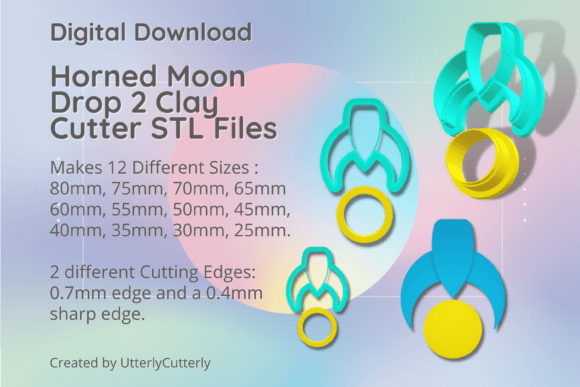
The Horned Moon Drop 2 Clay Cutter - Celesti represents more than a simple shaping tool; it is a strategic digital asset designed to streamline production workflows for polymer clay artists, cookie decorators, and small business owners. By acquiring this STL file bundle, creators gain immediate access to a versatile manufacturing system rather than a single static product. This digital download includes twelve distinct sizes and two specialized cutting edge profiles, allowing for precise calibration of output based on project requirements. For entrepreneurs and hobbyists utilizing 3D printing technology, this pack serves as a foundational element in building a proprietary library of custom tools that support brand consistency, operational efficiency, and creative differentiation.
Optimizing Production Through Technical Specification
Successful fabrication relies on understanding the technical parameters of your tools. The Horned Moon Drop 2 Clay Cutter - Celesti is engineered with specific tolerances to ensure reliability across different materials and printer configurations. Before initiating a print job, it is essential to distinguish between the two included cutter types to match the tool to the intended outcome. Making the wrong selection can lead to material waste, post-processing fatigue, or structural failure in the final piece.
- Standard Edge (0.7mm Wall): This variant features a 0.7mm wall thickness with a 3mm thick base and a total height of 12mm. It is strategically best suited for general-purpose cutting where durability and ease of handling are priorities. The thicker wall provides rigidity, reducing the risk of deformation during the pressing motion, which is critical when working with stiffer clays or doughs.
- Sharp Edge (SE): Abbreviated as SE in the file names, this version utilizes a 1mm support wall tapering to a precise 0.4mm cutting edge. Like the standard version, it maintains a 3mm base and 12mm height. This profile is intended for detailed work requiring clean, crisp incisions with minimal material displacement. It reduces drag on delicate mediums but requires careful handling to prevent damage to the fine edge.
Both variations adhere to a consistent 12mm height, ensuring ergonomic uniformity across your toolkit. Furthermore, any embossing lines integrated into the design are set at 10.5mm tall. This specific dimension dictates that users must prepare clay sheets thicker than 1.5mm to achieve full definition without bottoming out. Understanding these constraints prevents trial-and-error printing and ensures that every iteration of the Horned Moon Drop 2 Clay Cutter - Celesti performs as intended.
Strategic Sizing for Product Line Cohesion
Versatility in product development often stems from scalable design systems. This STL bundle provides twelve graduated sizes, measured from the longest ends: 80mm, 75mm, 70mm, 65mm, 60mm, 55mm, 50mm, 45mm, 40mm, 35mm, 30mm, and 25mm. This granular sizing strategy allows creators to curate cohesive collections rather than isolated items. For jewelry makers, this range facilitates the creation of matching sets, such as statement earrings paired with smaller studs or pendants. For culinary applications, it enables tiered presentation designs or portion-controlled baking.
When planning inventory or custom orders, consider how these sizes interact with other assets in your digital library. Because the Horned Moon Drop 2 Clay Cutter - Celesti follows standardized measurement logic, it integrates seamlessly with other STL files from our store. New designs are released weekly, allowing you to build a modular ecosystem of cutters. This interoperability is key to long-term scalability; instead of searching for disparate tools that may not align aesthetically or dimensionally, you can rely on a unified system that supports rapid prototyping and consistent branding.
Operational Considerations for Digital Assets
Transitioning from physical tool acquisition to digital fabrication requires a shift in operational mindset. When you purchase the Horned Moon Drop 2 Clay Cutter - Celesti, you are not receiving a physical item. Access to the files is granted immediately upon payment confirmation. This instant delivery model eliminates shipping delays, enabling just-in-time production. However, it also places the responsibility of quality control squarely on the user’s printing setup and material choices.
To maximize the return on this digital investment, establish a standardized printing protocol. Test prints should be conducted to verify dimensional accuracy, as slicer settings and filament shrinkage rates vary. A cutter designed at 80mm may print at 79mm or 81mm depending on your machine's calibration. Documenting successful print profiles for both the Standard and Sharp Edge variants saves time on future projects. Additionally, maintain an organized digital asset management system. With new STL files added to the store weekly, a chaotic file structure can negate the efficiency gains of digital ownership. Tagging files by size, edge type, and collection name ensures that the Horned Moon Drop 2 Clay Cutter - Celesti remains accessible and functional within your broader workflow.
Mitigating Risks in Tool Fabrication
While 3D printing offers autonomy, it introduces variables that do not exist with mass-manufactured tools. Relying on the Horned Moon Drop 2 Clay Cutter - Celesti without clear goals or context can lead to inefficient resource allocation. Printing all twelve sizes in both edge variants immediately is rarely a sound strategy. Instead, adopt an iterative approach. Print one size in each edge profile to test performance against your specific medium—whether that be porcelain clay, polymer clay, or cookie dough.
Consider the end-use environment. The Sharp Edge (SE) variant, while superior for detail, is inherently more fragile due to its 0.4mm tip. If the intended application involves high-pressure cutting or automated rolling processes, the SE version may fail prematurely. Conversely, using the robust 0.7mm Standard Edge for intricate lace-like clay work may result in torn edges and excessive cleanup time. Aligning tool selection with material properties and mechanical stress is a critical decision-making step. Furthermore, always verify licensing terms regarding commercial use of printed objects versus the resale of the STL files themselves. Protecting your business integrity involves respecting intellectual property boundaries while leveraging these tools for legitimate value creation.
Enhancing Creative Positioning and Brand Identity
In saturated markets, differentiation is paramount. The Horned Moon Drop 2 Clay Cutter - Celesti offers a distinctive aesthetic that can become a signature element of your brand identity. Rather than treating this cutter as a generic utility, integrate it intentionally into your product narrative. The "Celesti" designation suggests celestial themes; leveraging this association can strengthen marketing messaging and visual coherence across social media platforms and e-commerce listings.
Thoughtful use extends beyond the shape itself. Experiment with combining multiple sizes to create negative space designs or layered compositions that competitors using standard round cutters cannot replicate. The ability to produce custom tools on demand means you can respond to trends faster than traditional supply chains allow. If a specific size or variation of the Horned Moon Drop 2 Clay Cutter - Celesti resonates with your audience, you can scale production instantly without waiting for restocks. This agility transforms a simple STL file into a competitive advantage, supporting goals related to market responsiveness, customer satisfaction, and unique value proposition.
Long-Term Value and Continuous Improvement
The true value of digital fabrication assets lies in their longevity and adaptability. Unlike physical cutters that degrade, wear down, or break, the Horned Moon Drop 2 Clay Cutter - Celesti STL file remains pristine indefinitely. You can reprint replacements at zero marginal cost (excluding filament and electricity), ensuring business continuity even if tools are lost or damaged. This permanence supports sustainable business practices by reducing waste associated with disposable or short-lived tooling.
As you expand your capabilities, revisit this asset periodically. Advances in 3D printing technology, such as higher resolution resin printers or stronger engineering filaments, may unlock new applications for existing files. A cutter that performed adequately in PLA two years ago might yield exceptional results in carbon-fiber-reinforced nylon today. Staying informed about material science and printer advancements allows you to extract ongoing value from your initial purchase. Ultimately, the Horned Moon Drop 2 Clay Cutter - Celesti is a platform for continuous learning and refinement, empowering creators to make better decisions, improve product quality, and achieve sustainable growth in their craft or business.