Kite 2 Clay Cutter - Donut Geometric STL: Digital Precision for Makers
For polymer clay artists and small business owners, the difference between a handmade charm and a professional product often lies in the consistency of the tools used. The Kite 2 Clay Cutter - Donut Geometric STL bridges the gap between organic creativity and geometric precision. This digital download provides immediate access to a versatile set of cutting files designed specifically for 3D printing, allowing creators to produce uniform shapes for jewelry, culinary arts, and mixed media projects without waiting for shipping or relying on mass-produced metal cutters that may not fit a specific design vision.
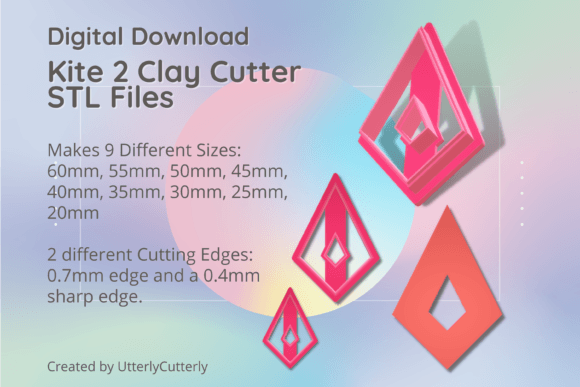
Rather than purchasing a single physical tool, this bundle offers nine distinct sizes ranging from 20mm to 60mm, measured from the longest ends. This scalability is essential for makers who need to create cohesive collections. Whether you are designing a graduated set of earrings or matching fondant decorations for a tiered cake, having exact size increments ensures your final pieces look intentional and polished. The digital nature of the Kite 2 Clay Cutter - Donut Geometric STL means you can print exactly what you need, when you need it, reducing waste and storage clutter in your studio.
Selecting the Right Blade Profile for Your Material
One of the most critical aspects of working with this STL pack is understanding the two distinct cutter types included. Not all materials behave the same way under pressure, and using the wrong blade profile can lead to tearing, dragging, or loss of detail. This bundle addresses that challenge by offering two specialized edge configurations tailored to different applications.
- The Standard Edge: Featuring a 0.7mm wall thickness, a 3mm thick base, and a 12mm height, this version is the workhorse for softer materials. It is ideal for cookie dough, fondant, and softer polymer clays where a slightly wider edge prevents the material from sticking inside the cutter. The sturdier wall provides rigidity, making it easier to press through thicker mediums without the cutter flexing or deforming.
- The Sharp Edge (SE): Abbreviated as SE in the file names, this variant features a 1mm support wall tapering down to a precise 0.4mm cutting edge. Like the standard version, it maintains a 3mm base and 12mm height for ergonomic handling. This profile is engineered specifically for polymer clay jewelry making. The finer edge slices cleanly through conditioned clay, minimizing the need for post-cut sanding and preserving crisp geometric lines that define the donut kite aesthetic.
Choosing between these profiles should be based on your primary medium. If you run a bakery and also make clay earrings, you now have dedicated tools for both without compromising the quality of either output. Always check the file naming convention before printing to ensure you are slicing the correct version for your current project.
Real-World Applications Across Creative Disciplines
The geometric kite donut shape is uniquely positioned because it combines angular modernism with a soft, rounded interior. This duality makes the Kite 2 Clay Cutter - Donut Geometric STL applicable across several distinct markets and hobbies.
Jewelry Design and Small Business Production
For earring makers, consistency is currency. Customers expect pairs to be identical, and this STL bundle facilitates that level of quality control. The 20mm and 25mm sizes are particularly popular for lightweight stud earrings, while the 30mm to 40mm range works beautifully for statement dangles. Because the files are digital, you can reprint a cutter if it wears out or gets lost, ensuring your production line never stops. The sharp edge variant allows for clean cuts that reduce finishing time, directly impacting profit margins for sellers on platforms like Etsy or at craft fairs.
Culinary Arts and Event Styling
Beyond clay, the larger sizes in this pack serve the culinary community. The 50mm, 55mm, and 60mm cutters are excellent for creating geometric cookies or fondant toppers that align with modern wedding aesthetics or minimalist birthday themes. Unlike traditional metal cutters that can rust or harbor bacteria in seams, 3D printed cutters made from food-safe PLA can be part of a hygienic kitchen workflow when used correctly. The standard 0.7mm edge glides through rolled fondant without dragging, creating sharp silhouettes that photograph well for social media content.
Educational and Therapeutic Settings
Educators and art therapists often seek tools that are safe, durable, and visually engaging. The geometric nature of the kite donut shape introduces concepts of symmetry and negative space in a tactile way. For sensory play or fine motor skill development, the larger cutters provide an easy grip for children or individuals with limited dexterity. Since these are printed on-demand, educators can replace broken tools instantly and even involve students in the printing process as part of a STEM curriculum, connecting digital design with physical creation.
Technical Considerations for Successful Printing
Owning the Kite 2 Clay Cutter - Donut Geometric STL is only the first step; achieving functional tools requires proper printer calibration. These files are designed to be easily printed, but user setup plays a significant role in the final quality. When slicing the Sharp Edge (SE) files, pay close attention to layer height and nozzle diameter. A 0.4mm nozzle is generally recommended to accurately reproduce the fine cutting edge. Printing too fast or with insufficient cooling can cause the thin edge to curl or blob, rendering the cutter ineffective for detailed clay work.
If your design includes embossing lines, note that they are set at 10.5mm tall. This specification is crucial for planning your material preparation. To get a clear impression without cutting through the clay entirely, your rolled slab must be thicker than 1.5mm. Attempting to use embossing features on thin clay will result in punctures rather than surface texture. Understanding these dimensional relationships before you begin prevents wasted material and frustration.
Additionally, consider your filament choice. While standard PLA is sufficient for occasional use, PETG or ABS may offer better durability for high-volume commercial production or warmer environments. However, always verify food safety certifications if you intend to use the cutters for edible products, as the safety of the final tool depends as much on the filament source as the STL geometry itself.
Curating a Custom Tool Library
One of the distinct advantages of adopting digital cutters like the Kite 2 Clay Cutter - Donut Geometric STL is the ability to build a modular tool library. Physical cutters take up drawer space and represent a sunk cost if a trend passes. Digital files allow you to curate custom combos that evolve with your style. With new STL files added to the store weekly, you can mix and match sizes and shapes to develop signature collections that competitors cannot easily replicate with generic supplies.
This flexibility extends to prototyping. Before committing to a large batch of jewelry, you can print a single test cutter to verify scale and proportion against your hardware findings. Perhaps a 35mm earring looks too heavy with your chosen ear wires; with digital files, you can simply switch to the 30mm version and reprint in minutes. This rapid iteration cycle empowers makers to refine their products based on real-world testing rather than guesswork.
Ultimately, this bundle represents a shift toward self-sufficient manufacturing for individual creators. By mastering the use of these STL files, you gain independence from supply chain delays and limited retail selections. You are not just buying a shape; you are acquiring the capability to produce professional-grade tools tailored to your specific creative and commercial needs.