Long Trapezoid 1 Clay Cutter: Digital STL Files for Precision Crafting
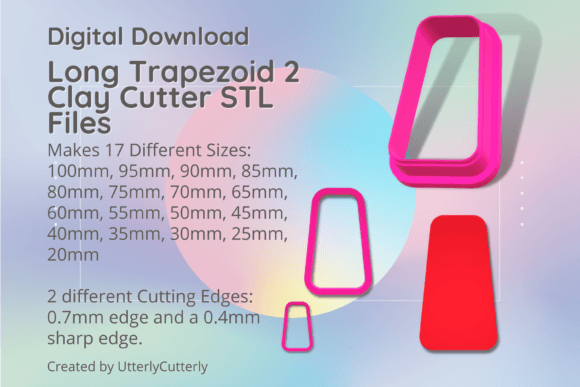
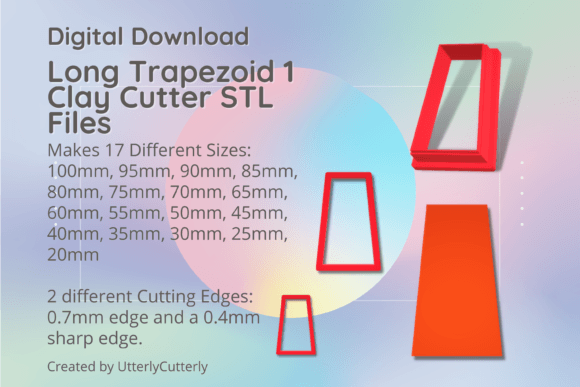
For makers utilizing polymer clay, ceramic materials, or culinary mediums like fondant, the transition from generic tools to specialized equipment often marks a shift in professional quality. The Long Trapezoid 1 Clay Cutter - Basic Sha represents this shift in the digital fabrication space. Rather than purchasing a single physical tool with fixed dimensions, this resource provides a comprehensive bundle of STL files designed for 3D printing. This approach addresses a common bottleneck in small-scale manufacturing and hobbyist production: the lack of size gradation. By offering 17 distinct sizes and two specific cutting edge profiles, this digital asset allows creators to maintain geometric consistency across varying scales, which is essential for producing cohesive jewelry sets, tiered decorative elements, or matched product lines.
Technical Specifications and Print Profiles
The utility of any 3D printed cutter relies entirely on the engineering of the STL file. Poorly designed digital files result in fragile prints, clogged nozzles, or ragged edges that require excessive post-processing. The Long Trapezoid 1 Clay Cutter - Basic Sha package mitigates these issues through two distinct design variations included in the download. Understanding the difference between these profiles is critical for selecting the right tool for your specific material and printer capabilities.
The Standard 0.7mm Wall Profile
This version features a 0.7mm wall thickness with a 3mm thick base and a total height of 12mm. From a practical standpoint, this is the more forgiving option for FDM (Fused Deposition Modeling) printers. A 0.7mm wall typically corresponds to two perimeters on a standard 0.4mm nozzle, creating a robust structure that resists warping during the print process. This profile is ideal for:
- Denser Materials: Suitable for firmer polymer clays or cookie dough where higher pressure is applied during cutting.
- Beginner Printing: More tolerant of minor calibration issues or older printer hardware.
- Durability: Less likely to snap if dropped or subjected to lateral stress during demolding.
The Sharp Edge (SE) Profile
Abbreviated as SE in the file naming convention, this variation utilizes a 1mm support wall tapering to a precise 0.4mm cutting edge. It shares the same 3mm base and 12mm height as the standard version but offers superior cutting performance. The 0.4mm edge approaches the limit of standard FDM resolution, requiring a well-tuned machine. However, the trade-off is significant: cleaner cuts with minimal drag. This profile reduces the "squish" effect often seen with thicker cutters, preserving the exact trapezoidal geometry of the clay. It is particularly valuable for delicate jewelry components where edge definition determines the final aesthetic quality.
Size Gradation and Workflow Integration
A defining characteristic of the Long Trapezoid 1 Clay Cutter - Basic Sha collection is the systematic sizing strategy. The bundle includes 17 incremental sizes ranging from 20mm to 100mm in 5mm steps (20, 25, 30, 35, 40, 45, 50, 55, 60, 65, 70, 75, 80, 85, 90, 95, and 100mm). Note that these measurements refer to the longest ends of the trapezoid.
This granular sizing solves a frequent design problem. When creating nested designs or graduated earring sets, makers often struggle to find commercially available cutters that share identical proportions at different scales. With this digital library, the aspect ratio remains constant regardless of size. For professionals managing custom orders, this eliminates guesswork. If a client requests a pendant that is exactly 15% smaller than a prototype, you can select the mathematically appropriate cutter rather than attempting to resize a physical impression manually.
Furthermore, the 12mm height accommodates embossing lines up to 10.5mm tall. Users should note that this requires working with clay slabs thicker than 1.5mm to prevent the embosser from bottoming out. This specification highlights the importance of matching your slab roller settings to your tooling parameters before beginning production.
Material Versatility Beyond Polymer Clay
While primarily marketed toward jewelry makers, the geometric simplicity and food-safe potential of PLA-printed cutters extend their value to other domains. The long trapezoid shape is architecturally versatile, functioning effectively in several contexts:
- Culinary Arts: The sharp edge profile excels with fondant, gum paste, and cookie dough. The smooth exterior walls facilitate easy release without tearing delicate sugar work.
- Ceramics: For potters working with leather-hard clay, the rigid 3mm base provides necessary leverage. The trapezoid form serves as an excellent building block for slab-built vessels or tile patterns.
- Mixed Media: The cutters can be used with air-dry clays, resin putties, or even wax sheets for lost-wax casting processes.
Users intending to use these for food applications must ensure they are printing with certified food-safe filament and adhering to proper hygiene protocols, as layer lines in 3D prints can harbor bacteria. Many professionals coat their culinary cutters in food-grade epoxy to create a seamless surface.
Evaluating Practical Value and Limitations
Adopting digital assets like the Long Trapezoid 1 Clay Cutter - Basic Sha requires an honest assessment of your current workflow. This is not a plug-and-play solution for those without access to a 3D printer or the willingness to learn basic slicing software. However, for those already integrated into digital fabrication, the value proposition is strong.
Cost Efficiency: Purchasing 17 individual metal or plastic cutters would represent a significant capital expenditure. The digital bundle amortizes this cost instantly, allowing for unlimited replacements and iterations at the price of filament.
Customization Potential: Because you possess the source geometry, you can modify the files if needed. While the pack is designed to be print-ready, advanced users can scale, add textures, or combine shapes in CAD software before printing.
Storage and Organization: Physical tools require storage space and inventory management. Digital files occupy negligible space and can be organized systematically on a drive, reducing workshop clutter.
However, there are limitations. Print time is a factor; producing the full set of 17 sizes will take several hours depending on your printer's speed and infill settings. Additionally, the 0.4mm sharp edge variant may fail on printers with worn nozzles or poor bed adhesion. Users should expect a learning curve when dialing in settings for the SE files, potentially wasting some material during initial calibration.
Target Audience and Application Fit
This digital collection is best suited for specific user profiles. Serious hobbyists and professional jewelry designers who produce volume-based collections will see the highest return on investment. Educators teaching geometric design or ceramics may also find the graduated size set useful for demonstrating scale and proportion. Conversely, casual crafters who make one-off projects may find the requirement to print and manage 17 files unnecessary overhead.
The Long Trapezoid 1 Clay Cutter - Basic Sha also appeals to sellers on platforms like Etsy who differentiate through unique, proprietary shapes. Using widely available commercial cutters limits design distinctiveness. By leveraging specialized digital files, creators can offer products that cannot be easily replicated by competitors using standard catalog items. The weekly release schedule of new STL files from this vendor further supports this business model, enabling shops to refresh their inventory regularly without sourcing new physical suppliers.
Optimizing Your Digital Fabrication Setup
To maximize the effectiveness of this cutter bundle, consider the following operational recommendations. First, organize your slicer presets specifically for cutter production. Create separate profiles for the 0.7mm and SE variants, adjusting flow rate and cooling accordingly. Second, implement a labeling system for your physical prints. Since the trapezoids differ by only 5mm increments, visual identification can be difficult. Consider printing the size directly onto the handle base or maintaining a labeled storage rack.
Finally, treat this digital purchase as part of a broader ecosystem. The interoperability of these files with other STL packs allows for curated combinations. A long trapezoid might serve as the primary frame for a barrette, while smaller sizes from the same pack create matching accent pieces. This systemic approach to tooling transforms isolated purchases into a comprehensive production library, ultimately streamlining the path from digital concept to tangible product.