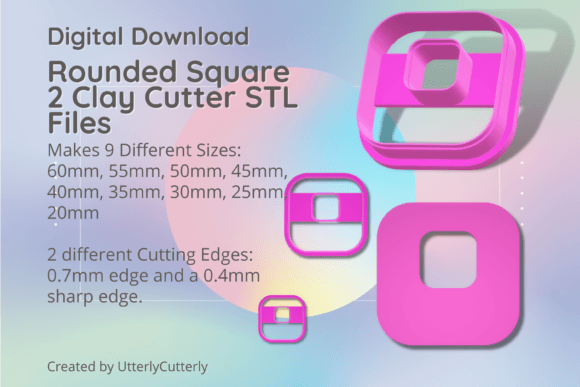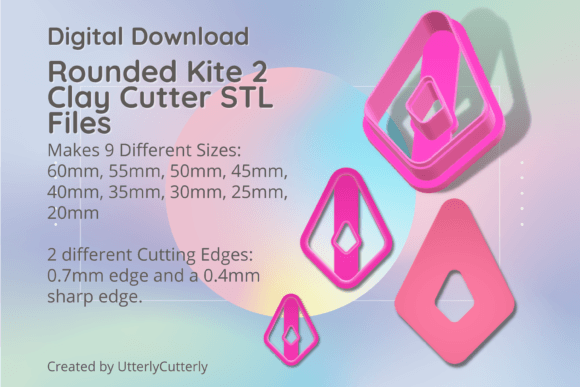
Mastering Geometric Design with the Rounded Kite 2 Clay Cutter - Donut Geome STL Collection
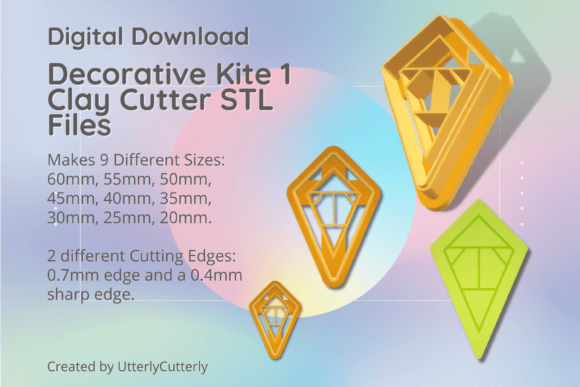
The intersection of digital fabrication and traditional handcrafting has revolutionized how artisans approach jewelry making and culinary arts. At the forefront of this hybrid workflow is the Rounded Kite 2 Clay Cutter - Donut Geome, a specialized digital asset designed for creators who demand precision and versatility. This collection of STL files represents more than just a cutting tool; it is a comprehensive system for producing consistent, geometrically complex shapes in polymer clay, ceramic clay, fondant, and cookie dough. By utilizing a bundle of nine distinct sizes and two specialized cutting edge profiles, makers can transition from prototyping to production with a level of repeatability that hand-cutting simply cannot achieve.
Dual-Edge Engineering for Material Versatility
A critical consideration when selecting digital cutter files is the compatibility between the blade geometry and the material being shaped. The Rounded Kite 2 collection addresses this by offering two distinct cutter types within the same download package. Understanding the mechanical differences between these edges is essential for optimizing print settings and achieving clean results across different mediums.
The Standard 0.7mm Wall Profile
The first variant features a robust 0.7mm wall thickness paired with a 3mm thick base and a total height of 12mm. This profile is engineered for durability and ease of printing. The wider wall provides structural integrity during the slicing process, reducing the risk of nozzle clogs or layer separation on standard FDM printers. In application, this edge is ideal for softer materials such as fondant, marzipan, and softer polymer clays. The slightly thicker blade acts as a wedge, displacing material rather than shearing it, which prevents sticking and ensures the donut geometric shape releases cleanly from sugar pastes without tearing delicate edges.
The Sharp Edge (SE) Variant
For professional jewelry makers working with firm polymer clays like Cernit or Fimo Professional, the Sharp Edge (abbreviated as SE in the file names) is the superior choice. This design utilizes a 1mm support wall that tapers down to a precise 0.4mm cutting edge. While this requires more careful tuning of printer flow rates and cooling fans, the result is a blade that slices through dense clay with minimal resistance. The reduced surface area of the cutting edge decreases friction, preventing the distortion of intricate geometric curves. Like the standard version, the SE variant maintains the 3mm base and 12mm height specifications, ensuring ergonomic handling and uniform pressure distribution regardless of the blade type selected.
Strategic Sizing for Cohesive Collections
Creating a unified product line often requires scaling designs while maintaining proportional integrity. The Rounded Kite 2 Clay Cutter - Donut Geome bundle eliminates the guesswork of manual resizing, which can distort aspect ratios and ruin geometric symmetry. The inclusion of nine graduated sizes allows for systematic collection building.
- 60mm and 55mm: Optimal for statement pendants, large barrettes, or substantial cookie decorations where bold visual impact is required.
- 50mm, 45mm, and 40mm: The versatile mid-range suitable for standard earrings, brooches, and medium-sized fondant toppers.
- 35mm, 30mm, 25mm, and 20mm: Designed for delicate stud earrings, charm components, ring faces, and miniature cake accents.
This granular sizing strategy enables creators to curate custom combos easily. For example, a jeweler might use the 50mm cutter for a necklace pendant and the 25mm version for matching studs, guaranteeing that the "donut geome" aesthetic remains identical across different scales. Furthermore, because these are digital files, users can mix and match these sizes with other STL assets from the store to create layered, multi-dimensional pieces without worrying about physical inventory storage.
Embossing Line Considerations
Users should note specific dimensional constraints regarding texture. If the design includes embossing lines, they are modeled at a height of 10.5mm. Given the total cutter height of 12mm, this leaves a 1.5mm clearance. Consequently, this tool functions best with clay sheets thicker than 1.5mm. Attempting to use thinner clay may result in the embossing detail failing to register clearly or the clay adhering to the top interior of the cutter. Adhering to this thickness guideline ensures that the geometric definition translates perfectly from the digital model to the physical object.
Optimizing the Digital-to-Physical Workflow
Since this product is exclusively a digital download, the quality of the final physical tool depends entirely on the user's 3D printing parameters. The files are designed to be easily printed, but achieving professional-grade cutters requires attention to specific slicer settings.
Print Orientation and Adhesion
Cutters should always be printed with the cutting edge facing up and the base plate against the build surface. This orientation eliminates the need for supports on the cutting edge itself, preserving its sharpness. A brim is often recommended over a raft, as it provides sufficient adhesion for the 3mm base while being easier to remove without damaging the delicate perimeter of the kite shape. For the Sharp Edge variants, increasing the number of perimeter walls to three or four can enhance the rigidity of the thin blade during the initial layers.
Material Selection for Food Safety and Durability
While PLA is the most common material for printing clay cutters due to its ease of use and biodegradability, the intended application dictates the best filament choice. For jewelry making, standard PLA or PETG offers sufficient stiffness and smoothness. However, for cookie and fondant applications, users must consider food safety. Standard 3D prints have layer lines that can harbor bacteria. If using these cutters for food, it is advisable to coat them in a food-safe epoxy resin or use certified food-safe filaments, understanding that the cutter is a single-use or limited-use item in culinary contexts. For non-food crafts, PETG or ABS may offer greater longevity and resistance to the chemicals found in certain polymer clay conditioners.
Applications Beyond Traditional Jewelry
While the primary audience for the Rounded Kite 2 Clay Cutter - Donut Geome includes jewelry designers, the geometric precision of this STL bundle extends its utility to several other creative disciplines. Educators and researchers in design fields utilize these standardized shapes to teach principles of geometry, symmetry, and negative space. The consistent sizing allows students to focus on surface treatment and assembly techniques rather than struggling with inconsistent hand-cutting.
In the culinary sector, the larger sizes serve as modern alternatives to traditional biscuit cutters. The rounded kite geometry offers a sophisticated aesthetic for high-end patisserie work, particularly when used with rolled fondant or gum paste. Unlike metal cutters which are fixed in size and expensive to customize, this digital approach allows bakers to iterate on decoration sizes instantly based on the dimensions of the cake or pastry being decorated.
For mixed media artists, these cutters provide a method for creating uniform components from air-dry clay, paper clay, or even wax. The ability to download new STL files weekly means that a maker’s toolkit is never static. As trends shift toward organic geometry or structured minimalism, having access to an evolving library of cutter designs allows businesses and hobbyists to adapt their offerings rapidly without investing in new manufacturing molds.
Maximizing Value Through Digital Asset Management
Purchasing a digital STL bundle differs fundamentally from buying physical tools. It grants the user perpetual access to the design data. To maximize this value, creators should establish an organized file management system. Labeling folders by size, edge type, and design family (such as "Donut Geome") streamlines the workflow when sitting down to print. Because the cutter size is measured from the longest ends, users should verify their slicer’s scaling settings before printing to ensure the 60mm file actually produces a 60mm cutter, accounting for any potential shrinkage specific to their filament and printer calibration.
Ultimately, the Rounded Kite 2 Clay Cutter - Donut Geome collection exemplifies the efficiency of modern digital crafting. By providing multiple edge profiles and a comprehensive size range in a single package, it removes technical barriers and allows artists to focus on creativity. Whether producing hundreds of earring blanks for a holiday market or experimenting with new textural effects on polymer clay, these digital files serve as the foundational infrastructure for consistent, high-quality handmade goods.