Orchid Set Digital STL File: Precision Clay Cutters
Elevating polymer clay jewelry and ceramic crafts requires more than just skillful hands; it demands tools that translate delicate botanical details into physical form. The Orchid Set Digital STL File serves as a bridge between digital design and tangible artistry, offering a specialized collection of cutters designed specifically for the intricate geometry of orchid blooms. Unlike generic floral shapes, this set captures the distinct asymmetry and layered petal structure that defines the orchid’s visual personality. For creators focusing on nature-inspired accessories, bridal embellishments, or high-end craft merchandise, having access to precise, scalable digital files ensures consistency across production runs while maintaining the organic feel essential to botanical design.
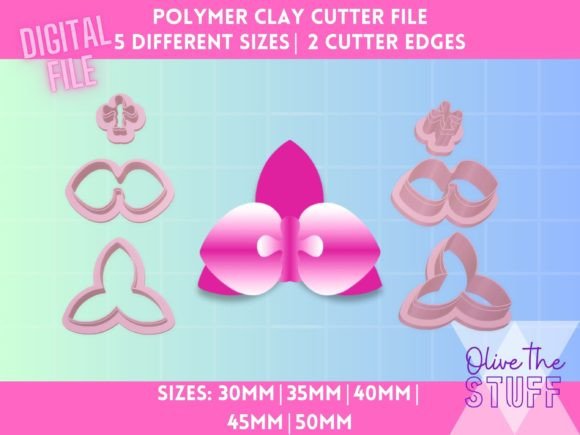
This digital asset is not merely a shape outline but a engineered tool system. The set includes five distinct sizes ranging from 30mm to 50mm, measured by the widest point of the flower. This scalability allows designers to create cohesive collections where motif size varies intentionally rather than arbitrarily. Whether you are producing statement earrings requiring a 50mm footprint or delicate ring accents at 30mm, the proportional integrity of the orchid remains intact. The availability of these specific increments—30mm, 35mm, 40mm, 45mm, and 50mm—eliminates the guesswork often associated with resizing vector files manually, preserving the crisp edges necessary for professional-grade results.
Engineering Two Distinct Cutting Profiles
A critical aspect of working with polymer clay is managing material displacement. Different clays have varying elasticity and memory, and different projects require different edge finishes. Recognizing this, the Orchid Set Digital STL File provides two specialized cutter edge profiles within the same package. Understanding the mechanical difference between these options is vital for achieving the desired surface quality without excessive post-processing.
The Normal Edge Cutters feature a robust .7mm wall thickness paired with a substantial 3mm base. This configuration prioritizes durability and ease of handling. The wider base acts as a comfortable grip pad, distributing pressure evenly during the cutting motion. This is particularly beneficial when working with firmer clay bodies or when producing larger batches where hand fatigue becomes a factor. The .7mm wall creates a slightly softer transition at the cut line, which can be advantageous for designs intended to have a rustic or hand-formed aesthetic. It also offers greater structural rigidity for the printed tool itself, reducing the risk of layer separation during use.
Conversely, the Sharp Edge Cutters are engineered for precision definition. These utilize a razor-thin .4mm blade wall supported by a .7mm reinforcement wall. This hybrid construction delivers the cleanest possible slice through the clay, minimizing drag and deformation. The result is an edge that requires little to no smoothing, preserving the sharpest details of the orchid’s lip and petal veins. However, this performance comes with trade-offs. The thinner profile demands careful handling and is best suited for softer, well-conditioned clays. For artisans selling premium jewelry where edge clarity signals quality, the sharp variant is often the superior choice despite its more delicate nature.
Technical Considerations for 3D Printing Success
Acquiring the Orchid Set Digital STL File is only the first step; successful implementation depends entirely on your fabrication capabilities. Because these tools rely on thin walls and precise tolerances, they serve as an excellent stress test for your 3D printer’s calibration. Before committing to a full production set, it is imperative to understand the limitations of your specific hardware.
- Nozzle Diameter: The sharp edge variant features a .4mm blade wall. If you are using a standard 0.4mm nozzle, you are printing at the absolute limit of your extrusion width. Any flow rate inconsistency or belt slippage could result in gaps or weak layers. A 0.2mm or 0.3mm nozzle is strongly recommended for the sharp cutters to ensure multiple perimeters and adequate strength.
- Material Selection: PLA is generally sufficient for the Normal Edge cutters due to their thicker geometry. However, the Sharp Edge cutters benefit significantly from tougher materials like PETG, ABS, or resin. Standard PLA can become brittle at .4mm thicknesses, leading to catastrophic failure mid-cut. Resin printers offer superior resolution for these fine details but require careful washing to prevent uncured resin from contaminating your clay.
- Orientation and Supports: Always print cutters vertically with the cutting edge facing up. This places the layer lines perpendicular to the cutting force, maximizing strength. Printing horizontally creates weak points along the layer seams exactly where stress is highest. Ensure your bed adhesion is dialed in perfectly, as the small footprint of the 30mm cutter can easily detach during printing.
- Slicing Parameters: Increase wall counts over infill percentage. For the Normal Edge, 3-4 walls provide ample rigidity. For the Sharp Edge, prioritize outer wall quality settings, slower print speeds for external perimeters, and precise cooling to prevent warping of the thin blade section.
Integrating Botanical Tools into Creative Workflows
While typography and font pairing dominate discussions about digital design assets, physical design tools like the Orchid Set Digital STL File play an equally crucial role in brand identity for makers. Consistency in shape language builds recognition just as effectively as a consistent typeface. When customers see your work, the distinctive silhouette of your orchid cutouts becomes part of your visual signature. Using a standardized, professionally engineered cutter set ensures that every piece bearing your label shares the same DNA, reinforcing brand perception through manufacturing precision.
For content creators and bloggers documenting their process, the dual-edge capability offers narrative depth. Demonstrating the difference between the Normal and Sharp cuts provides educational value to your audience while showcasing your technical expertise. This moves content beyond simple inspiration into practical instruction, increasing engagement and establishing authority within the crafting niche. Photographing the raw cut edges alongside finished pieces highlights the importance of tool selection, turning a behind-the-scenes detail into a compelling story about craftsmanship.
Small business owners should also consider the commercial implications of tool reliability. Downtime caused by broken cutters or inconsistent shapes directly impacts profitability. By selecting the appropriate edge profile for your specific clay body and production volume, you optimize workflow efficiency. The 3mm base on the Normal Edge cutter, for example, isn't just a comfort feature; it's a productivity enhancer that reduces strain during marathon creation sessions. Similarly, investing time to properly calibrate prints for the Sharp Edge variant pays dividends in reduced finishing time per unit. In handmade markets where margins are tight, these incremental efficiencies compound significantly over time.
Ultimately, the Orchid Set Digital STL File represents a convergence of digital accessibility and analog craft tradition. It empowers creators to produce complex botanical forms with repeatable accuracy while retaining the flexibility to adapt tools to their specific material constraints. Whether you are designing a new jewelry line, creating tutorial content, or refining your studio workflow, understanding the technical nuances of these cutters transforms them from simple plastic shapes into integral components of your creative practice. Always verify your printer's capabilities against the specified wall thicknesses before purchasing, ensuring that your digital investment translates successfully into physical excellence.