Wave Bar 1 Clay Cutter - STL Digital File: Strategic Production for Makers
The Wave Bar 1 Clay Cutter - STL Digital File represents more than a simple geometric shape; it is a foundational asset for polymer clay artists, cookie decorators, and small business owners seeking production consistency. In the competitive landscape of handmade goods, the ability to replicate specific designs with precision is what separates hobbyists from professional brands. This digital download provides immediate access to a versatile cutting tool system designed specifically for additive manufacturing. By integrating this STL bundle into your workflow, you gain control over your inventory, reduce reliance on external suppliers, and establish a proprietary aesthetic that can be scaled across jewelry, accessories, and culinary applications.
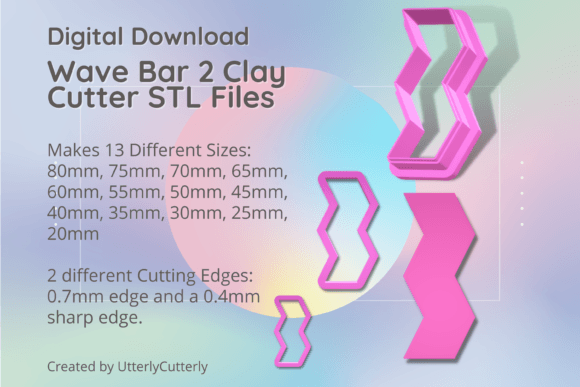
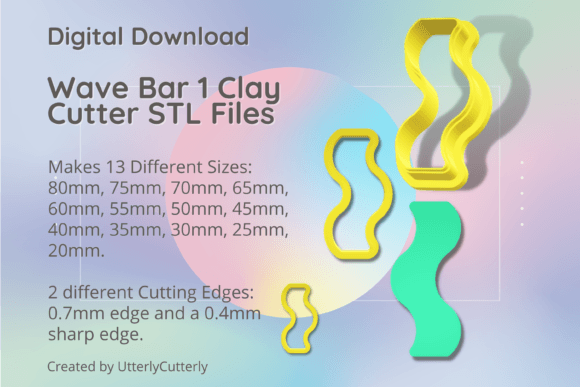
Strategic acquisition of digital fabrication files allows creators to decouple their creative output from shipping delays and stock shortages. When you utilize the Wave Bar 1 Clay Cutter - STL Digital File, you are essentially securing a perpetual license to produce a core component of your product line. The design features two distinct cutting edge profiles and thirteen graduated sizes, offering a level of operational flexibility that physical, pre-made cutters rarely provide. This adaptability is crucial for makers who need to pivot quickly between product categories or adjust sizing based on seasonal trends and customer feedback without incurring additional capital expenditure.
Technical Specifications and Manufacturing Considerations
Understanding the technical parameters of your STL files is a prerequisite for successful printing and consistent end-product quality. The Wave Bar 1 Clay Cutter - STL Digital File includes two distinct cutter types, each engineered for specific material behaviors and finish requirements. Making an informed decision between these variants prevents wasted filament and failed prints.
- Standard Edge (0.7mm Wall): This variant features a 0.7mm wall thickness with a 3mm thick base and a total height of 12mm. It is structurally robust and ideal for stiffer clays, fondant, or cookie dough where durability during the pressing motion is paramount. The thicker wall reduces the risk of deformation during printing and extends the lifespan of the cutter when working with dense materials.
- Sharp Edge (SE): Abbreviated as SE in the file set, this version utilizes a 1mm support wall tapering to a precise 0.4mm cutting edge. Like the standard version, it maintains a 3mm base and 12mm height. This geometry is strategically superior for soft polymer clays and detailed jewelry work where clean release and minimal drag are necessary to preserve surface texture.
All thirteen sizes in this bundle range from 20mm to 80mm, measured from the longest ends. This comprehensive size gradient supports strategic product tiering. For example, a jewelry maker might use the 20mm and 25mm cutters for delicate stud earrings, the 40mm and 50mm sizes for statement pendants, and the 70mm+ options for hair barrettes or decorative elements. Having this full spectrum available in a single digital package eliminates the friction of sourcing mismatched tools later.
Embossing Integration and Material Thickness
A critical operational detail often overlooked in digital fabrication is the relationship between cutter depth and material volume. If your specific Wave Bar 1 configuration includes embossing lines, they are designed at a height of 10.5mm. Consequently, this tool requires a minimum clay thickness of 1.5mm to function correctly. Attempting to use this cutter on thinner sheets will result in incomplete impressions or structural failure of the piece. Strategic planning involves conditioning your clay to a consistent gauge before cutting to ensure the embossing engages fully without piercing through the substrate. This specification dictates your preparation workflow and should inform your standard operating procedures for batch production.
Strategic Applications Across Product Lines
The versatility of the Wave Bar 1 Clay Cutter - STL Digital File lies in its cross-industry utility. While primarily marketed to clay artists, the geometric form factor translates effectively to other mediums. Diversifying the application of a single digital asset improves return on investment and maximizes the value of your 3D printing infrastructure.
Jewelry and Accessories: The wave bar silhouette is inherently modern and fluid, making it suitable for contemporary earring designs and minimalist pendants. The availability of smaller sizes (20mm–35mm) allows for the creation of cohesive collections rather than isolated pieces. By using the Sharp Edge (SE) variant, makers can achieve crisp boundaries that require less post-processing sanding, directly reducing labor hours per unit.
Culinary Arts and Baking: Food safety and hygiene are primary concerns when transitioning digital tools to edible mediums. Because you print these cutters yourself, you have full oversight of the material safety. Using food-safe PLA or PETG with the Standard Edge variant creates durable tools for fondant, gum paste, and cookie dough. The larger sizes (60mm–80mm) are particularly valuable for creating uniform cookies for wedding favors or branded corporate events, where visual consistency is a key deliverable.
Hair Accessories: Barrettes and hair clips require structural integrity alongside aesthetic appeal. The mid-range sizes (45mm–60mm) offer an optimal balance for adult hair accessories. The wave shape provides natural grip points and visual interest, while the digital nature of the file allows you to iterate on thickness or reinforcement ribs if testing reveals a need for greater durability.
Risk Management and Intentional Usage
Acquiring digital files carries inherent risks if approached without a clear production strategy. The most common pitfall is treating STL files as generic commodities rather than specialized tooling. Without proper calibration, even the best-designed Wave Bar 1 Clay Cutter - STL Digital File will yield poor results.
Printer Calibration: Before committing to a production run, validate your printer’s dimensional accuracy. A 0.4mm sharp edge requires precise extrusion width and flow rate calibration. Over-extrusion can blunt the cutting edge, rendering the SE variant useless, while under-extrusion can compromise layer adhesion on the thin walls. Allocate time for test prints and tolerance checks.
Material Compatibility: Not all filaments behave identically. Standard PLA may be too brittle for repeated use with stiff clay, while TPU may be too flexible to hold the wave shape during cutting. Test multiple materials to determine which offers the best balance of rigidity and longevity for your specific use case. Document these findings to create a reliable reference for future reprints.
Design Context: Avoid using the wave bar cutter in isolation. Its strategic value increases exponentially when combined with complementary shapes. Plan your collection architecture so that the wave bar serves as either a primary motif or a supporting element. Random usage dilutes brand identity; intentional curation builds recognition.
Optimizing Workflow and Long-Term Value
To maximize the long-term value of this digital asset, integrate it into a broader operational framework. The Wave Bar 1 Clay Cutter - STL Digital File is part of an ecosystem where new designs are released weekly. This regular cadence suggests a strategy of incremental collection building rather than one-off projects.
- Establish a Digital Asset Library: Organize your STL files systematically by size, edge type, and intended application. Clear naming conventions prevent errors during high-volume printing sessions and reduce setup time.
- Create Print Profiles: Develop dedicated slicer profiles for both the 0.7mm and SE variants. Optimized settings for wall count, infill density, and cooling should be saved to ensure repeatability. Do not rely on generic presets.
- Prototype Before Production: Always print a single test cutter before batching. Verify dimensions against calipers and test functionality with your actual working medium. This validation step prevents costly material waste and protects your reputation for quality.
- Monitor Wear Patterns: Digital tools are renewable, but they are not immortal. Track how many uses each printed cutter withstands before degradation occurs. This data informs your replacement schedule and helps forecast filament consumption.
By approaching the Wave Bar 1 Clay Cutter - STL Digital File with this level of intentionality, you transform a simple download into a scalable production capability. The goal is not merely to own the file, but to master its application within your unique creative or commercial context. Whether you are launching a new jewelry line, expanding a bakery’s custom offerings, or refining your craft practice, success depends on aligning technical specifications with strategic objectives. Remember that this is a digital product; your access begins immediately upon purchase, enabling rapid deployment and iterative improvement without the latency of traditional supply chains.