1920s Frill Rectangle 1 Clay Cutter - Ar: Digital STL Evaluation
The 1920s Frill Rectangle 1 Clay Cutter - Ar is a digital asset designed for makers who utilize 3D printing technology to create custom tools for polymer clay, fondant, and cookie dough. This product is not a physical tool but rather a downloadable STL file bundle that allows users to manufacture their own cutters on demand. The design captures the geometric elegance and decorative frills characteristic of Art Deco aesthetics, making it specifically relevant for creators focusing on vintage-inspired jewelry, barrettes, and culinary decorations. Understanding the technical specifications and practical applications of this digital download is essential for determining whether it aligns with specific production needs and printer capabilities.
Design Versatility and Application Scope
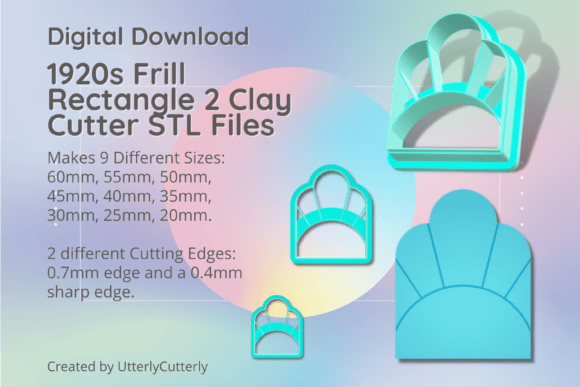
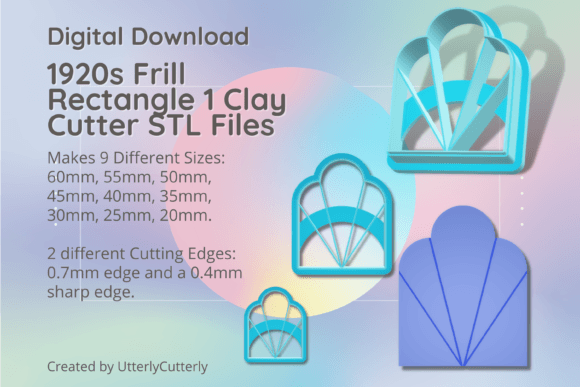
The primary value proposition of the 1920s Frill Rectangle 1 Clay Cutter - Ar lies in its adaptability across different mediums. While marketed heavily toward polymer clay artists creating earrings and pendants, the rectangular arch geometry with frilled detailing serves multiple purposes. For jewelry makers, the shape provides a structured yet ornate frame that differs from standard oval or circular cutters. In culinary applications, the same geometry translates effectively to fondant work and cookies, provided the user selects the appropriate edge type. The inclusion of nine distinct sizes, ranging from 20mm to 60mm, allows for cohesive collection building. A creator can produce matching sets, such as a pendant and earring set, or scale up to larger statement pieces without losing design fidelity. This size gradation eliminates the need to source multiple individual files, streamlining the digital library management process for active makers.
Technical Specifications and Print Considerations
Evaluating this STL bundle requires a close examination of the two distinct cutting edge profiles included in the download. The choice between these profiles significantly impacts both the printing process and the final utility of the cutter.
- Standard Edge (0.7mm Wall): This variant features a 0.7mm wall thickness with a 3mm thick base and a total height of 12mm. It is generally more forgiving during the printing process and offers greater structural rigidity. This option is often preferable for beginners or those using printers with less precise calibration. However, the thicker wall may leave a slightly wider impression on soft materials, requiring additional cleanup or sanding after cutting.
- Sharp Edge (SE): Abbreviated as SE in the file names, this version utilizes a 1mm support wall tapering to a 0.4mm cutting edge. Like the standard version, it has a 3mm base and 12mm height. The sharper edge produces cleaner cuts in polymer clay and fondant, reducing material drag and deformation. The tradeoff is increased difficulty in printing; the thin 0.4mm tip requires optimal cooling and nozzle precision to prevent layer shifting or fragility.
Users must also consider the embossing specifications. Any embossing lines within the design are set at 10.5mm tall. This dimension dictates that the material being cut must be thicker than 1.5mm to accommodate the relief without compromising the structural integrity of the clay or dough. Attempting to use this cutter on thinner sheets will result in perforation rather than a clean impression, limiting its utility for delicate veneer work.
Benefits of Digital STL Assets Over Physical Tools
Opting for the 1920s Frill Rectangle 1 Clay Cutter - Ar digital download presents several logistical advantages over purchasing pre-manufactured metal or plastic cutters. The most immediate benefit is inventory control. Makers can print replacement tools instantly if a cutter breaks or becomes dull, eliminating downtime associated with shipping delays. Additionally, digital files allow for on-demand scaling. If a project requires a 48mm cutter but only 45mm and 50mm options exist physically, the digital nature of this pack allows the user to slice the file at an intermediate percentage to achieve the exact dimension needed. This level of customization is impossible with fixed-size physical inventory.
Furthermore, the economic model favors high-volume users. Once the initial file cost is absorbed, the marginal cost of producing additional cutters is limited to filament and electricity. For sellers who frequently test new designs or require disposable cutters for food safety compliance, this cost structure is significantly more sustainable than accumulating physical stock.
Tradeoffs and Limitations
Despite the flexibility, there are objective tradeoffs to selecting a digital STL over a physical product. The primary barrier is the requirement for hardware ownership and technical proficiency. Users must possess a functioning 3D printer and understand slicing software parameters such as layer height, infill density, and brim adhesion. Poorly printed cutters can have rough layer lines that tear clay or harbor bacteria in food applications, rendering them unsafe or ineffective.
Material durability is another consideration. PLA and PETG, the most common filaments for hobbyist printing, lack the longevity of stainless steel or brass. Printed cutters may warp if exposed to heat during clay conditioning or degrade over time with repeated washing. The 0.4mm Sharp Edge variant, while superior for cutting quality, is inherently more fragile and prone to snapping if excessive force is applied during demolding. Users must weigh the convenience of instant access against the reduced lifespan and maintenance requirements of printed tools.
Situational Fit and Alternative Options
The 1920s Frill Rectangle 1 Clay Cutter - Ar is a strong fit for makers who already own a 3D printer and specialize in Art Deco or vintage reproduction styles. It is particularly suitable for those who value size consistency across a product line and wish to avoid the storage overhead of physical tools. The bundle format makes it ideal for creators planning a themed collection where multiple scales of the same motif are required.
Conversely, alternatives should be considered in specific scenarios. Makers without 3D printing access should seek physical cutters or commission a printing service, as the learning curve and equipment cost outweigh the benefits of a single STL file. Those working exclusively with extremely thin clay sheets (under 1.5mm) should look for non-embossed outline cutters, as the 10.5mm emboss depth of this design is incompatible with their medium. Finally, professional bakers requiring commercial-grade sanitation certification may prefer food-safe stainless steel cutters, as verifying the food safety of home-printed plastics and filaments remains a complex regulatory gray area.
Making the Decision
Selecting the right cutter format ultimately depends on balancing workflow efficiency with output quality. When evaluating the 1920s Frill Rectangle 1 Clay Cutter - Ar, prospective users should assess their current printer's ability to handle fine details before committing to the Sharp Edge variant. Testing the 0.7mm standard edge first can serve as a benchmark for machine calibration. Additionally, buyers should verify that the 20mm to 60mm size range encompasses their intended projects, as resizing beyond these bounds may distort the frill proportions. By treating this digital download as a component of a broader manufacturing system rather than a standalone solution, makers can effectively integrate it into their creative process while managing expectations regarding print quality and material limitations.