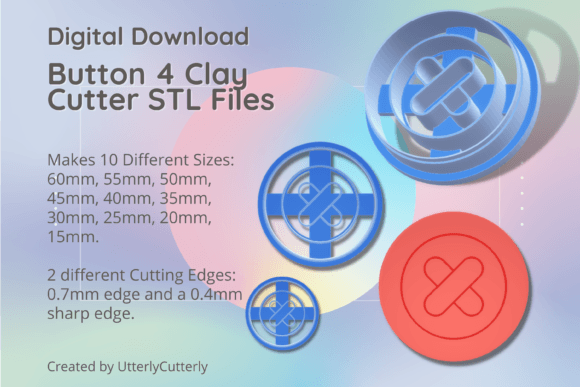
Button Shape 1 Clay Cutter STL: Digital Design Guide
For makers utilizing 3D printing technology to produce polymer clay jewelry, fondant decorations, or ceramic components, the precision of the cutting tool directly dictates the quality of the final product. The Button Shape 1 Clay Cutter - Crafter STL provides a specialized digital solution for creators who require consistent, geometric arch shapes across multiple scales. Rather than purchasing physical tools that may wear down or lack specific sizing, this digital download allows users with access to FDM or resin printers to manufacture their own production-grade cutters on demand. This approach shifts the focus from sourcing supplies to optimizing workflow, enabling artisans to maintain a cohesive aesthetic across earrings, pendants, barrettes, and culinary projects without waiting for shipping or settling for generic sizes.
Optimizing Print Settings for Dual Edge Profiles
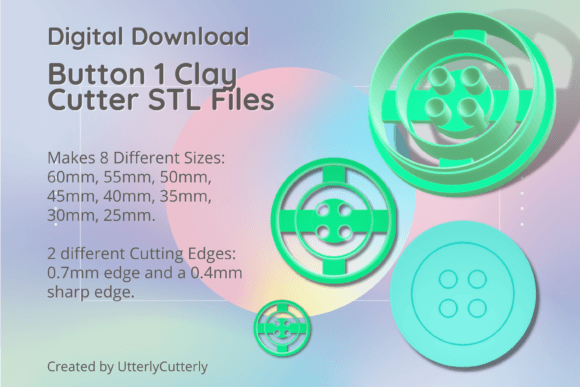
A critical advantage of this STL bundle is the inclusion of two distinct cutting edge profiles designed for different material behaviors. Understanding when to use each variant prevents wasted filament and ensures clean cuts. The first option features a 0.7mm wall thickness with a 3mm base and 12mm height. This robust profile is engineered for durability and repeated use with denser materials like cookie dough or firm fondant. The thicker wall resists flexing during compression, maintaining the integrity of the button arch shape even under significant pressure. For polymer clay artists working with softer clays or requiring intricate detail, the Sharp Edge (SE) variant offers a superior alternative. Abbreviated as SE in the file names, this version utilizes a 1mm support wall tapering to a precise 0.4mm cutting edge. While still maintaining the standard 3mm base and 12mm height for ergonomic handling, the reduced blade width slices through conditioned clay with minimal resistance, reducing drag marks and deformation.
When printing the SE files, users should prioritize nozzle diameter and layer height settings. A 0.4mm nozzle is generally sufficient, but printing at 0.12mm or 0.08mm layer heights can significantly improve edge definition. Because the cutting edge is narrow, ensuring adequate cooling is essential to prevent the thin plastic from softening during the print process. Conversely, the 0.7mm standard cutters are more forgiving and can often be printed successfully at standard 0.2mm layer heights, making them ideal for rapid prototyping or batch production of tools for heavier media.
Strategic Sizing for Cohesive Jewelry Collections
Professional jewelry design relies heavily on proportion and scale. Having access to eight specific sizes—60mm, 55mm, 50mm, 45mm, 40mm, 35mm, 30mm, and 25mm—allows creators to develop graduated collections rather than isolated pieces. Note that these measurements refer to the longest ends of the cutter, providing an accurate reference for planning component relationships. A maker designing a statement necklace might utilize the 60mm and 55mm cutters for focal pendants, while employing the 30mm and 25mm versions for matching stud earrings or bracelet charms. This dimensional consistency creates a professional, curated look that is difficult to achieve when mixing tools from disparate manufacturers.
The ability to print specific sizes on demand also solves inventory management issues for small business owners. Instead of stocking dozens of physical cutters "just in case," digital storage replaces physical clutter. If a custom order requires a specific size ratio not currently in your toolkit, you can print the exact Button Shape 1 Clay Cutter - Crafter STL needed within hours. This agility supports made-to-order business models and reduces overhead costs associated with unused tooling. Furthermore, because the files are compatible with other STL designs in the crafter ecosystem, users can mix and match arch shapes with complementary textures or outlines to create unique composite designs without compatibility concerns.
Navigating Embossing Depths and Material Thickness
Users must pay close attention to material preparation when utilizing cutters with integrated embossing lines. In this STL pack, any embossing details are set at a height of 10.5mm relative to the base. Given the total cutter height of 12mm, this leaves only 1.5mm of clearance between the embossing feature and the top rim. To ensure the embossed design registers clearly without the cutter bottoming out prematurely, the clay slab must be rolled to a thickness greater than 1.5mm. Working with clay thinner than this threshold will result in shallow impressions or incomplete cuts, as the rim will contact the work surface before the embossing line fully penetrates the material.
This technical constraint serves as a practical guide for slab preparation. Using roller guides or slat sets calibrated to 2mm or 3mm ensures optimal results. For bakers using these cutters for fondant or cookie dough, this depth specification helps gauge how much leeway exists for decoration without compromising structural integrity. If the goal is purely cutting without embossing, users can select non-embossed variants if available, or simply accept that the embossing line acts as a depth stop. Understanding these mechanical limitations transforms potential frustration into predictable, repeatable outcomes.
Workflow Integration for Multi-Disciplinary Makers
The versatility of the Button Shape 1 Clay Cutter - Crafter STL extends beyond jewelry studios into culinary and educational environments. For cake decorators, the arch shape offers a modern alternative to traditional round buttons, adding architectural interest to vintage-style cakes or gender-neutral baby shower treats. The food-safe nature of the printed tool depends entirely on the user's choice of filament and post-processing; PLA is generally considered safe for brief contact with dry fondant, while PETG may offer better moisture resistance. Educators and workshop facilitators benefit from the digital format by being able to print enough identical cutters for every student in a class, eliminating the logistical challenge of sharing limited physical resources. Each participant receives the same high-quality tool, ensuring equitable learning experiences and consistent project outcomes.
For freelancers and content creators documenting their process, the uniformity of 3D-printed tools enhances visual presentation. Custom-colored filaments can distinguish different sizes or edge types in video tutorials, improving viewer comprehension. The matte finish typical of FDM prints also reduces glare under studio lighting compared to glossy metal alternatives. This attention to visual detail matters for bloggers and marketers whose revenue depends on engaging imagery. By treating tool fabrication as part of the creative brand identity, makers reinforce their expertise and commitment to quality craftsmanship.
Considerations for Digital File Management
Since this is a digital download and not a physical item, immediate access after payment enables uninterrupted creative flow. However, digital assets require organized file management to remain useful over time. Users should establish a clear naming convention and folder structure upon download, particularly given the multiple sizes and edge variants included. Labeling folders by project type or material application can streamline retrieval during active work sessions. Additionally, keeping backup copies of the original STL files protects against corruption or accidental modification during slicing software adjustments.
While the convenience of digital files is significant, users should realistically assess their printer’s calibration capabilities before committing to large-scale production. The 0.4mm sharp edge demands a well-tuned machine; printers with worn nozzles or poor extrusion consistency may struggle to reproduce this geometry accurately. Testing one size in both edge variants before printing the full set validates printer performance and saves material. Comparing test prints against the specified dimensions ensures that scaling factors in slicer software haven’t altered the intended size. This verification step is especially important for makers combining these cutters with previously printed tools, where cumulative tolerance errors could affect assembly or fit. By approaching digital fabrication with the same rigor as traditional craft techniques, users maximize the value of the Button Shape 1 Clay Cutter - Crafter STL and build a sustainable, efficient production workflow tailored to their specific creative goals.