Cat Head 1 Clay Cutter - Animal STL Digi: Optimizing Your Digital Fabrication Workflow
The transition from purchasing physical tools to acquiring digital assets like the Cat Head 1 Clay Cutter - Animal STL Digi represents a significant shift in how creators approach polymer clay, fondant, and cookie design. This digital download provides immediate access to a versatile bundle of animal-themed cutters designed specifically for 3D printing. However, owning the file is only the first step; achieving professional results requires understanding the technical nuances of STL fabrication. Many makers assume that downloading a file guarantees a perfect tool, but without proper attention to print settings, size selection, and edge geometry, even high-quality designs can fail during production.
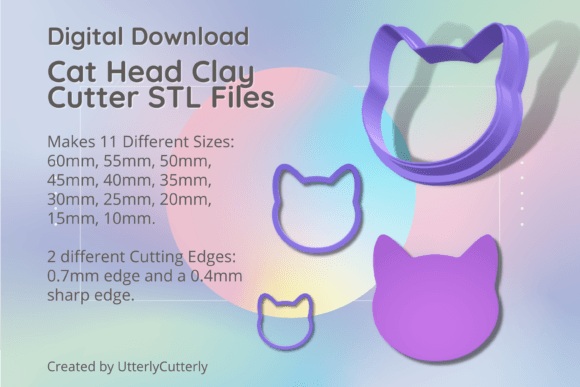
This digital pack includes 11 distinct sizes ranging from 10mm to 60mm and two specialized cutting edge profiles. Understanding these variables is essential for avoiding wasted filament and frustrating crafting sessions. Whether you are creating delicate jewelry earrings or substantial fondant decorations, treating this digital asset with technical precision ensures your printed tools perform as intended.
Selecting the Correct Edge Profile for Your Medium
A common oversight when printing the Cat Head 1 Clay Cutter - Animal STL Digi is ignoring the distinction between the two included cutter types. This bundle offers two specific geometries, and choosing the wrong one for your material leads to poor release, tearing, or excessive cleanup time.
- Standard Edge (0.7mm Wall): This version features a 0.7mm wall thickness, a 3mm thick base, and a 12mm height. It is robust and durable, making it ideal for softer mediums like fondant, cookie dough, or soft polymer clay. The slightly thicker wall provides structural integrity, preventing the cutter from warping under pressure.
- Sharp Edge (SE): Abbreviated as SE in the file names, this variant has a 1mm support wall tapering to a precise 0.4mm cutting edge. It shares the same 3mm base and 12mm height but is engineered for detailed polymer clay work where crisp definition is paramount.
Makers often default to the Sharp Edge for all projects, assuming sharper is always better. However, using a 0.4mm edge on sticky fondant or dense cookie dough can cause the material to adhere to the thin blade, resulting in distorted shapes. Conversely, using the standard 0.7mm edge for intricate polymer clay jewelry may leave rough edges requiring excessive sanding. Always match the file type to your medium: use SE for clay and Standard for food or soft pastes.
Navigating Size Variations and Measurement Standards
Digital files eliminate shipping wait times, but they introduce the risk of dimensional misunderstanding. A frequent source of dissatisfaction stems from misinterpreting how cutter sizes are calculated. In this collection, sizes range from 10mm up to 60mm (10, 15, 20, 25, 30, 35, 40, 45, 50, 55, and 60mm). Crucially, these measurements refer to the longest end of the design, not necessarily the width or height of the bounding box.
If you are designing a pair of earrings with a strict 30mm width requirement, selecting the "30mm" cat head file might result in a piece that is actually narrower than expected if the cat’s ears extend further than the face width. Before printing the entire bundle, print a single test size and measure the actual output against your project specifications. This verification step prevents batch-printing eleven sizes that do not fit your intended jewelry findings or packaging dimensions. Additionally, because these are digital files, you have the freedom to scale them in your slicer software, but be aware that scaling affects wall thickness proportionally. Scaling down a Sharp Edge cutter below 15mm may render the 0.4mm tip too fragile for practical use.
Critical Considerations for Embossing and Clay Thickness
For creators utilizing the embossing features within the Cat Head 1 Clay Cutter - Animal STL Digi, clay thickness is a non-negotiable variable. Any embossing lines in this design are set at 10.5mm tall relative to the base. With a total cutter height of 12mm, this leaves minimal clearance.
You must condition and roll your clay to be thicker than 1.5mm to accommodate these details. If your clay slab is thinner than 1.5mm, the embossing detail will either fail to transfer completely or punch through the material entirely, ruining both the piece and potentially sticking clay into the cutter’s internal crevices. Use calipers or consistent roller guides to verify slab thickness before cutting. This is particularly important for beginners who tend to roll clay unevenly; an inconsistent slab will yield inconsistent impressions regardless of the STL file's quality.
Print Settings and File Management Best Practices
Since this is a digital download and not a physical item, the quality of the final tool depends entirely on your printer calibration. These cutters are designed to be easily printed, but "easily" assumes correct orientation and layer management.
- Orientation: Always print cutters with the cutting edge facing up and the base plate on the build surface. Printing sideways creates layer lines along the cutting edge that transfer directly to your clay.
- Nozzle Selection: For the Sharp Edge (SE) files, a 0.4mm nozzle is generally sufficient, but a 0.2mm nozzle yields superior definition for the smallest sizes (10mm–25mm). The Standard 0.7mm wall prints reliably on most standard FDM printers.
- Infill and Perimeters: Cutters do not require high infill; 10-15% is adequate. Focus instead on perimeter count. Increasing walls to 3 or 4 perimeters strengthens the cutter more effectively than increasing infill density.
- File Organization: Upon payment, you receive immediate access to multiple STL files. Create a dedicated folder structure organized by size and edge type immediately after downloading. Renaming files to include dimensions and edge type (e.g., "CatHead_30mm_SE.stl") saves significant time during future projects.
Evaluating Versatility and Future Expansion
One advantage of integrating the Cat Head 1 Clay Cutter - Animal STL Digi into your workflow is the modular nature of digital libraries. New STL files are added to the store weekly, allowing you to curate custom combinations over time. When evaluating this purchase, consider how the 11 included sizes interact with other animal or geometric cutters you may acquire later.
The standardized base thickness (3mm) and height (12mm) across this collection ensure ergonomic consistency. This uniformity matters when you are working on large batches; switching between cutters of vastly different heights causes hand fatigue and inconsistent pressure application. By sticking to collections with matching specifications, you maintain a cohesive toolkit that supports efficient production, whether you are a hobbyist exploring new techniques or a small business owner fulfilling custom orders.
Ultimately, success with digital clay cutters relies on respecting the technical parameters of the files. By verifying measurements, selecting the appropriate edge profile, maintaining proper clay thickness for embossing, and optimizing print settings, you transform a simple STL download into a reliable manufacturing asset. Take the time to test and calibrate before committing to full production runs, and these digital tools will serve your creative business effectively for years to come.