Flower Drop 2 Clay Cutter - STL Digital: Optimizing Your 3D Printed Tools
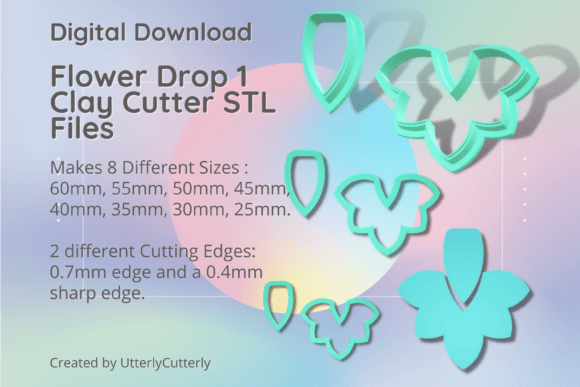
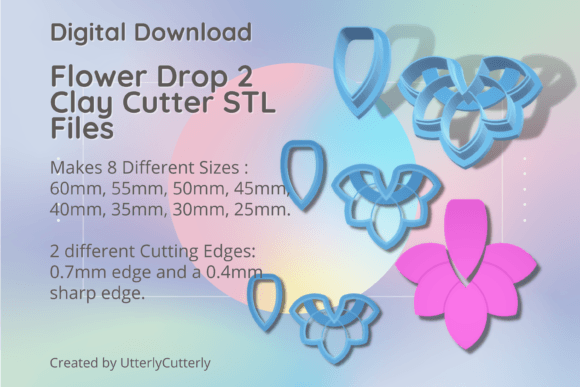
Creating consistent, professional-grade polymer clay jewelry or detailed cookies requires more than just artistic skill; it demands precision tooling. The Flower Drop 2 Clay Cutter - STL Digital offers a versatile solution for makers who own 3D printers and want to expand their inventory without waiting for shipping. This digital bundle provides immediate access to eight distinct sizes and two specialized cutting edge profiles, allowing you to curate custom sets tailored to specific project requirements. However, simply downloading an STL file does not guarantee success. Many creators overlook critical technical specifications regarding wall thickness, blade geometry, and clay depth, leading to warped prints, stuck clay, or broken cutters. Understanding how to properly evaluate and utilize these digital assets is essential for achieving high-quality results efficiently.
Selecting the Correct Blade Geometry for Your Material
A frequent mistake when working with digital cutter files is assuming that one blade type suits all applications. This pack includes two distinct variations, and choosing the wrong one can compromise both the tool's lifespan and the finish of your work. The first option features a 0.7mm wall with a 3mm thick base and 12mm height. This robust profile is ideal for firmer clays or cookie dough where structural integrity during pressing is paramount. The thicker wall resists flexing, ensuring the flower drop shape maintains its geometry under pressure.
Conversely, the Sharp Edge (SE) variant is abbreviated in the files for easy identification. It features a 1mm support wall tapering to a 0.4mm cutting edge, with the same 3mm base and 12mm height. This design is superior for soft polymer clays where clean slicing prevents dragging or distortion. A common error is using the standard 0.7mm wall on very soft clay, which can compress the material rather than slice it, resulting in ragged edges. Alternatively, using the delicate SE version on stiff dough or over-conditioned clay can cause the thin blade to buckle or snap. Always match the blade profile to the density of your medium to preserve print quality and reduce waste.
Understanding Size Measurements and Scaling Limitations
When browsing digital marketplaces, buyers often misinterpret how cutter sizes are listed, leading to frustration when the printed tool doesn't fit their intended design space. For the Flower Drop 2 Clay Cutter - STL Digital, sizes are measured from the longest ends of the shape, not the width of the bounding box or the center diameter. The included sizes range systematically: 60mm, 55mm, 50mm, 45mm, 40mm, 35mm, 30mm, and 25mm.
This distinction matters significantly for layout planning. If you are designing a pendant that must fit within a 40mm bezel, selecting the 40mm cutter based on longest-end measurement might actually yield a piece that is too wide at certain points depending on the flower drop’s aspect ratio. Before printing the entire set, measure your physical workspace or jewelry findings against the actual dimensions of the STL model in your slicer software. Additionally, avoid arbitrarily scaling these files. While 3D printing allows for resizing, altering the scale changes the blade-to-base ratio. Enlarging a 25mm cutter to 60mm may result in an unnecessarily thick blade that displaces too much clay, while shrinking the 60mm version could make the base too fragile to withstand hand pressure. Stick to the provided sizes or adjust your design expectations to match the engineered proportions.
Critical Considerations for Embossing and Clay Depth
One of the most overlooked technical details in digital cutter descriptions is the relationship between embossing line height and clay thickness. If your selected STL file includes integrated embossing details, note that these lines are 10.5mm tall. This specification dictates that you must work with clay thicker than 1.5mm to accommodate the relief without bottoming out.
Attempting to use this cutter on 1mm sheet clay will result in the embossing feature pressing completely through the material, sticking to the work surface, and potentially damaging the print. This is not a defect in the file but a mismatch in application. To avoid this, always calibrate your pasta machine or rolling pin guides to ensure a minimum 2mm depth when using embossed variants. If you prefer working with thinner clay, seek out non-embossed outline-only versions or plan to add surface texture separately after cutting. Recognizing this constraint before you begin conditioning your clay saves time, material, and the disappointment of ruined pieces.
Print Orientation and Bed Adhesion Strategies
Even with a perfectly designed STL, poor print execution renders the Flower Drop 2 Clay Cutter - STL Digital unusable. The 3mm base and 12mm height create a specific center of gravity that requires strategic orientation. Printing these cutters upright (standing on the base) is generally recommended to keep the cutting edge crisp and layer lines horizontal along the blade face. However, this tall, narrow footprint can be prone to knocking over.
To mitigate this, use a brim rather than a raft. Rafts can leave rough textures on the base that transfer to your clay, while brims provide stability without compromising the functional surface. Ensure your bed leveling is precise; a 0.4mm SE blade will fail if the first layer is squashed or uneven. Furthermore, because new STL files are added to the store weekly, treat each download as a unique test. Slicer settings that worked for last week’s geometric cutter may not optimize the curved walls of the Flower Drop 2. Print a single test cutter in draft mode to verify dimensional accuracy and edge sharpness before committing to a full batch production run.
Managing Digital Assets and Expectations
Finally, remember that this is strictly a digital product. You will not receive a physical item. Access to the files is granted immediately after payment, placing the responsibility of quality control on your equipment and settings. All cutters are tested before release, but "tested" assumes standard FDM printing parameters with appropriate nozzle sizes. Using a 0.8mm nozzle for a 0.4mm SE blade will physically fail to reproduce the geometry.
Verify your printer’s capabilities against the file specifications before purchasing. Keep your original STL files organized and backed up; re-downloading can sometimes lead to version confusion if updates occur. By approaching the Flower Drop 2 Clay Cutter - STL Digital with technical mindfulness rather than passive consumption, you transform a simple digital download into a reliable component of your creative workflow. This proactive mindset ensures that your investment yields beautiful, consistent jewelry or cookies, maximizing both efficiency and artistic satisfaction.