Evaluating the Oval Clay Cutter Basic Shape Geometric STL Bundle
The Oval Clay Cutter - Basic Shape Geometric represents a digital fabrication solution for artisans and hobbyists who require precise, consistent shaping tools for polymer clay, ceramic clay, fondant, or cookie dough. Unlike traditional metal cutters purchased as physical goods, this product is a digital download consisting of STL files designed for 3D printing. The bundle specifically targets makers who need versatility in sizing and edge definition without accumulating excessive physical inventory. By providing seventeen distinct sizes and two unique cutting edge profiles, this digital asset allows users to manufacture their own tools on demand, tailored to specific project requirements.
Understanding the Digital Asset Specifications
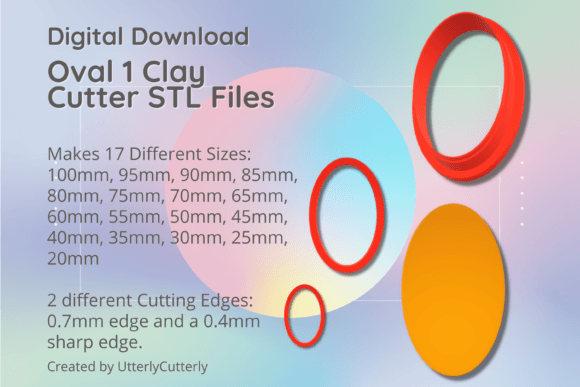
Before acquiring this STL bundle, it is essential to understand exactly what is included to determine if it aligns with current production needs. This package is not a single tool but a comprehensive library of geometric oval shapes. The sizing spectrum is extensive, ranging from 20mm to 100mm in 5mm increments. This granular size progression addresses a common limitation in commercial cutter sets, which often skip intermediate sizes that are crucial for creating nested designs or graduated jewelry sets.
Critically, the bundle offers two distinct cutter typologies within the same size range. Understanding the difference between these two profiles is vital for selecting the correct file for a specific material:
- Standard Edge (0.7mm Wall): This design features a 0.7mm wall thickness with a 3mm thick base and a total height of 12mm. It provides structural rigidity and is generally more durable during the printing process. This profile is suitable for general-purpose cutting where extreme sharpness is secondary to tool longevity.
- Sharp Edge (SE): Abbreviated as SE in the file names, this variant includes a 1mm support wall tapering to a 0.4mm cutting edge. Like the standard version, it has a 3mm base and 12mm height. The reduced contact surface at the cutting point allows for cleaner slices through softer materials like polymer clay or fondant, reducing drag and deformation.
Users should also note the embossing line specification. If utilizing files that include texture or embossing details, the lines are 10.5mm tall. This necessitates using clay slabs thicker than 1.5mm to ensure the design registers correctly without bottoming out or tearing the material.
Assessing Suitability for Jewelry and Culinary Applications
The primary value proposition of the Oval Clay Cutter - Basic Shape Geometric lies in its dual applicability to both craft and culinary sectors. For jewelry makers, the availability of sizes between 20mm and 50mm is particularly relevant for earrings, pendants, and barrettes. The ability to print multiple sizes allows for rapid prototyping; a maker can test three different earring scales in an hour rather than waiting for shipping on three separate metal cutters. The Sharp Edge (SE) files are typically preferred here, as polymer clay retains fingerprint marks and deformation easily, and a sharper blade minimizes post-processing sanding.
In culinary contexts, such as cookie decorating or fondant work, the larger sizes (60mm to 100mm) become the focal point. Food safety considerations are paramount when using 3D printed tools. While PLA is generally considered food-safe in composition, the layer lines inherent in FDM printing can harbor bacteria. Users intending to use these cutters for food must apply appropriate food-safe sealants or use them exclusively with non-porous barriers like plastic wrap. The Standard Edge profile may be preferable for cookies, as the slightly thicker wall can sometimes provide better leverage when pressing through denser doughs compared to the delicate SE variant.
Technical Considerations and Printing Requirements
Acquiring a digital STL file shifts the manufacturing responsibility to the user. Success with this product depends heavily on printer calibration and material selection. The 0.4mm cutting edge on the SE variants approaches the limit of standard 0.4mm nozzle capabilities. Users must have a well-tuned printer capable of accurate dimensional accuracy and proper cooling to prevent the thin walls from warping or failing during the print. Printers with worn nozzles or poor extrusion consistency may struggle to produce functional Sharp Edge cutters.
Material choice also influences performance. Standard PLA is rigid and holds an edge reasonably well for polymer clay but can be brittle. PETG offers more flexibility and durability, which can prevent cracking if excessive pressure is applied, though it may be more difficult to print with high detail. ABS or ASA provides superior heat resistance, which is beneficial if the cutters will be used near warm clay or in warmer environments, but requires an enclosed printer. Buyers without access to reliable 3D printing hardware or the technical knowledge to troubleshoot thin-wall prints may find the learning curve steep.
Comparing Digital STL Bundles vs. Physical Cutters
When evaluating whether to purchase this digital bundle or opt for traditional physical cutters, several tradeoffs emerge. Physical brass or stainless steel cutters offer superior edge retention, smoothness, and immediate usability. They do not require post-processing, sealing, or printing time. For professionals producing high-volume goods where tool failure is not an option, metal remains the industry standard.
However, the Oval Clay Cutter - Basic Shape Geometric bundle offers economic and logistical advantages that physical tools cannot match. The cost per cutter drops to mere cents after the initial file purchase, whereas buying seventeen individual metal cutters would represent a significant capital expense. Furthermore, digital files eliminate storage concerns and allow for infinite replacement. If a printed cutter breaks, it can be replaced in thirty minutes. This makes the STL bundle ideal for experimentation, low-volume custom work, and makers who prioritize variety over permanent tool ownership.
Making the Final Decision
This digital collection is best suited for makers who already possess competent 3D printing capabilities and desire expansive size options for geometric oval shapes. It serves as a foundational library that pairs well with other specialized STL files, allowing users to curate custom cutter combinations. The weekly release schedule of new designs mentioned by the provider suggests an ecosystem approach, making this basic geometric pack a logical starting point for building a comprehensive digital toolset.
Conversely, those without 3D printing experience, or those requiring food-safe certification without additional processing steps, should consider this product carefully. The requirement to measure from the longest ends and manage specific wall thicknesses indicates a product designed for informed users. Ultimately, the decision rests on whether the flexibility of on-demand manufacturing outweighs the convenience of ready-made physical tools. For the prepared maker, this bundle offers a practical, scalable solution for achieving precise geometric consistency across a wide range of creative applications.