Arch Shape 19 Clay Cutter - Arc STL Digi: Evaluating Digital Versatility for Polymer Clay and Baking
The transition from purchasing physical tools to acquiring digital assets represents a significant shift in how makers approach their craft. The Arch Shape 19 Clay Cutter - Arc STL Digi is not a tangible product shipped to your doorstep; it is a comprehensive digital bundle containing STL files designed for immediate local fabrication. For artisans working with polymer clay, ceramic clay, or cookie dough, this distinction fundamentally changes the workflow, cost structure, and creative potential. Understanding the specific technical parameters of this digital download is essential for determining whether it aligns with your current production needs and equipment capabilities.
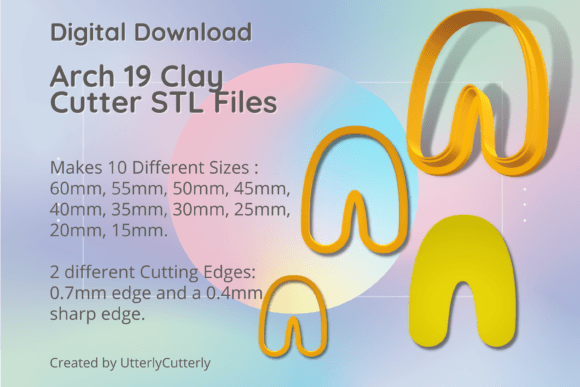
This specific digital pack distinguishes itself through granular sizing options and dual-edge engineering. Rather than offering a single static shape, the Arch Shape 19 collection provides ten distinct sizes ranging from 15mm to 60mm, measured from the longest ends. Furthermore, it addresses the common limitation of generic cutters by including two specialized cutting edge profiles within the same download. This level of customization allows users to adapt the tool to different material viscosities and project requirements without waiting for international shipping or settling for ill-fitting commercial alternatives.
Technical Specifications and Edge Variations
When evaluating STL files for functional tools, geometry dictates performance. The Arch Shape 19 Clay Cutter - Arc STL Digi includes two distinct cutter types, each engineered for specific outcomes. Selecting the correct profile is as important as selecting the correct size.
- Standard Wall (0.7mm): This variation features a 0.7mm wall thickness with a 3mm thick base and a total height of 12mm. The wider wall provides structural rigidity, making it less prone to warping during the printing process or deformation when pressing into stiffer materials like cold porcelain or dense cookie dough. It offers a balance between durability and cutting precision.
- Sharp Edge (SE): Abbreviated as SE in the file names, this version utilizes a 1mm support wall that tapers to a precise 0.4mm cutting edge. Like the standard version, it maintains a 3mm base and 12mm height. The reduced contact surface area at the cutting point allows for cleaner slices through soft polymer clays and fondant, minimizing drag and distortion. However, the thinner edge requires careful handling and optimal print settings to ensure layer adhesion.
Both variations share a consistent 12mm height, which serves as an ergonomic handle while providing sufficient clearance for most crafting applications. Users should note that if utilizing embossing features included in related designs, the embossing lines are typically 10.5mm tall. This specification necessitates using clay slabs thicker than 1.5mm to prevent the embosser from bottoming out or tearing the material.
Digital STL Bundles Versus Physical Inventory
Comparing the Arch Shape 19 digital download to traditional physical cutters reveals distinct tradeoffs. Physical cutters offer immediate utility with no barrier to entry beyond purchase. They are ideal for hobbyists without 3D printing infrastructure or those who require food-safe certified manufacturing guarantees that home printers cannot always provide.
Conversely, the digital format offers scalability and iterative improvement. With the Arch Shape 19 Clay Cutter - Arc STL Digi, the marginal cost of producing additional sizes is effectively zero. If a maker realizes mid-project that a 45mm arch is too large for a specific earring design, they can print a 35mm version immediately without placing a new order. This agility is particularly valuable for production artists fulfilling custom commissions where standard sizing often fails.
However, the digital route shifts quality control responsibilities to the user. Print orientation, layer height, nozzle temperature, and cooling rates will directly impact the finish and functionality of the cutter. A poorly calibrated printer may produce rough edges on the Sharp Edge variant or weak layer bonding on the 0.7mm walls. Makers must weigh their confidence in machine calibration against the convenience of ready-made tools.
Sizing Strategy and Modular Compatibility
The inclusion of ten incremental sizes (60mm, 55mm, 50mm, 45mm, 40mm, 35mm, 30mm, 25mm, 20mm, and 15mm) supports a modular approach to design. In jewelry making, having nested sizes allows for creating cohesive collections where pieces relate proportionally rather than arbitrarily. For example, a statement necklace might utilize the 60mm and 50mm arches, while matching earrings employ the 25mm and 20mm versions.
This sizing logic also facilitates comparison with other digital assets. Because the Arch Shape 19 series adheres to consistent measurement standards (longest end measurement), it integrates predictably with other STL files from the same ecosystem. When curating a custom toolkit, verifying that different packs share similar base thicknesses and height standards ensures that all printed tools feel uniform in hand and perform consistently across different projects.
Material Suitability and Application Contexts
The dual-edge design of the Arch Shape 19 Clay Cutter - Arc STL Digi acknowledges that no single geometry suits every medium. Understanding material interaction helps determine which file to slice.
Polymer Clay: The Sharp Edge (SE) variant is generally superior for conditioned polymer clay. The 0.4mm edge reduces resistance, preserving delicate textures and preventing the "elephant skin" effect caused by dragging. However, if the clay is particularly firm or cold, the Standard 0.7mm wall may provide necessary leverage without flexing.
Ceramic and Air-Dry Clays: These materials often contain abrasive particulates or higher moisture content. The Standard 0.7mm wall is typically recommended here. The increased surface area distributes pressure more evenly, reducing the risk of snapping the cutter edge. Additionally, the smoother outer wall of the standard variant is easier to clean of sticky ceramic residue compared to the intricate taper of the SE version.
Baking Applications: While STL files allow for endless customization, food safety remains a critical consideration. FDM 3D prints inherently possess layer lines that can harbor bacteria. If using these cutters for cookies or fondant, users should employ them exclusively with disposable barriers (plastic wrap) or seal the prints with food-safe epoxy resin. The 12mm height is adequate for most cookie doughs, but extremely thick gingerbread may require multiple passes or a deeper cutter not included in this specific set.
Evaluating Printability and Design Constraints
A primary advantage of professionally designed STL files like the Arch Shape 19 series is optimized printability. Generic free files often suffer from non-manifold geometry, insufficient wall thickness, or poor bed adhesion areas. This pack specifies a 3mm thick base, which acts as a built-in brim. This feature significantly increases first-layer success rates on various build plates and eliminates the need for excessive supports or rafts that degrade surface finish.
Despite these optimizations, limitations exist. The 0.4mm cutting edge on the SE variant approaches the practical limit of standard 0.4mm nozzles. Users with larger nozzles (0.6mm or 0.8mm) may find the sharp edge impossible to render accurately and should default to the 0.7mm standard version. Similarly, printers lacking adequate part cooling may struggle with the overhangs inherent in arch shapes. Evaluating your hardware's capabilities against the file specifications prevents wasted filament and time.
Making the Decision: When Digital is the Right Fit
The Arch Shape 19 Clay Cutter - Arc STL Digi represents a strategic resource for makers who value iteration over immediacy. It is best suited for:
- Production Artists: Those who need to scale designs up or down based on client feedback without inventory risk.
- Multi-Medium Crafters: Users who switch between clay, dough, and wax and benefit from having dedicated edge profiles for each.
- Tool System Builders: Makers actively curating a cohesive library of compatible digital assets rather than buying disparate physical tools.
- Geographically Remote Users: Individuals for whom shipping costs or delivery times for specialty tools are prohibitive.
Conversely, this digital bundle may not be the optimal choice for beginners still learning 3D printer maintenance, those requiring certified food-safe tools without post-processing capability, or hobbyists who only need a single size for occasional use. In those cases, the upfront cost and learning curve of digital fabrication may outweigh the long-term benefits.
Ultimately, the value of this digital download lies in its flexibility. By providing ten sizes and two functional edge geometries in a single package, it transforms a simple shape into a comprehensive system. Success depends less on the file itself and more on the user’s ability to match the technical specifications to their specific material, printer, and project goals. As new STL files are released weekly, treating this pack as part of a growing ecosystem rather than an isolated purchase maximizes its long-term utility in a modern maker’s workflow.