Mastering the Step Pyramid Arch 2 Clay Cutter: Aztec Geometry for Digital Fabrication
The intersection of ancient architectural motifs and modern additive manufacturing has created a niche yet expansive market for specialized crafting tools. Among these digital assets, the Step Pyramid Arch 2 Clay Cutter - Aztec collection stands out as a prime example of how historical design principles can be translated into functional STL files for contemporary makers. This digital download bundle offers more than just a shape; it provides a comprehensive system for creating geometrically precise artifacts ranging from polymer clay jewelry to culinary decorations. Understanding the technical specifications and practical applications of this specific cutter set is essential for professionals and hobbyists aiming to maximize the potential of their 3D printers.
Technical Specifications and Printability Analysis
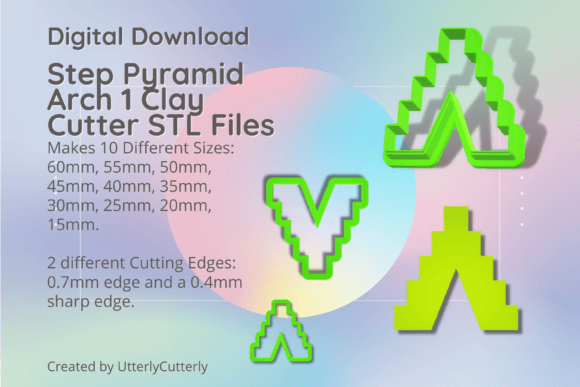
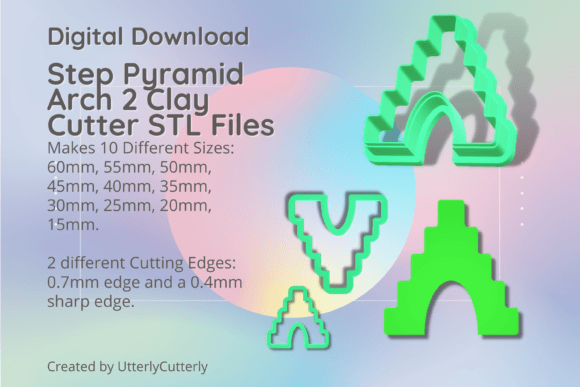
When acquiring digital fabrication files, the primary concern for any maker is printability and dimensional accuracy. The Step Pyramid Arch 2 Clay Cutter - Aztec bundle is engineered with specific tolerances that cater to both FDM (Fused Deposition Modeling) and resin printing technologies, though the design parameters suggest optimization for standard filament printers. The inclusion of ten distinct sizes, ranging from 15mm to 60mm, allows for a graduated scaling system that maintains structural integrity across the entire spectrum. This size variance is critical for creators who need to produce cohesive collections, such as matching earring and pendant sets or tiered cake decorations.
The bundle distinguishes itself through two distinct cutting edge profiles, each serving a unique mechanical purpose during the impression process:
- Standard Wall Profile: This variant features a 0.7mm wall thickness with a 3mm thick base and a total height of 12mm. The wider wall provides increased rigidity, making it ideal for stiffer materials like cold porcelain or dense fondant where lateral pressure might distort thinner cutters. The 3mm base ensures stability during the pressing motion, reducing the likelihood of uneven impressions.
- Sharp Edge (SE) Profile: Abbreviated as SE in the file naming convention, this version utilizes a 1mm support wall tapering to a precise 0.4mm cutting edge. Despite the finer edge, it retains the robust 3mm base and 12mm height of the standard model. This geometry is specifically calculated for clean release in polymer clay and soft doughs, minimizing drag and deformation while ensuring the intricate Aztec step details remain crisp.
A crucial technical consideration for users involves the embossing lines integrated into the design. These relief elements stand at 10.5mm tall, which dictates a minimum material thickness requirement. To achieve a successful impression without bottoming out or tearing the medium, users must prepare clay or dough sheets thicker than 1.5mm. This specification highlights the importance of using consistent rolling guides or pasta machine settings when preparing material for the Step Pyramid Arch 2 Clay Cutter - Aztec designs.
Material Versatility Across Creative Disciplines
While often categorized under jewelry making, the utility of these geometric arch cutters extends significantly beyond adornment. The Aztec step pyramid motif possesses a universal aesthetic that translates effectively across various mediums, provided the user understands the material-specific behaviors associated with each application.
Polymer Clay and Jewelry Fabrication
In the realm of wearable art, the sharp edge (SE) variants are the preferred choice. Polymer clay requires a blade that slices rather than compresses to maintain the definition of the stepped arch geometry. The 0.4mm edge facilitates this clean cut, allowing artisans to create lightweight earrings and pendants with professional-grade edges that require minimal post-processing sanding. The availability of sizes down to 15mm enables the creation of delicate studs and charm components, while the larger 50mm and 60mm sizes accommodate statement necklaces and hair barrettes. Because the files are digital, makers can experiment with scaling within their slicer software to create intermediate sizes not explicitly listed, offering limitless customization for bespoke jewelry lines.
Culinary Arts and Fondant Decoration
The transition from clay to kitchen requires an understanding of food safety and material viscosity. For cookies and fondant, the standard 0.7mm wall profile often performs better than the sharp edge. Doughs and sugar pastes are viscoelastic; they tend to spring back after cutting. A slightly thicker wall helps push the material aside cleanly and provides enough surface area to prevent the cutter from sinking uncomfortably into the hand during repetitive use. The Aztec geometric pattern creates visually striking cookie designs that play with light and shadow, particularly when used with royal icing flooding techniques that respect the stepped levels of the pyramid form. Users must ensure that any 3D printed tool used for food is either coated in a food-safe epoxy or used exclusively with a barrier film, as layer lines in printed plastic can harbor bacteria.
Optimizing Digital Workflows and Slicer Settings
Acquiring the STL file is merely the first step; achieving optimal results with the Step Pyramid Arch 2 Clay Cutter - Aztec requires thoughtful preparation in the slicing stage. Since these are functional tools rather than decorative models, print orientation and infill strategies differ from standard artistic prints.
Orientation Strategy: Always print cutters with the base plate flat against the build surface. Printing vertically or at an angle introduces layer lines along the cutting edge, which will transfer imperfections directly into the clay or dough. While supports might seem unnecessary for the arch shape, enabling tree supports or brims can sometimes enhance bed adhesion for the smaller 15mm and 20mm variants, preventing warping that would render the cutter unusable.
Wall and Infill Configuration: Regardless of whether you are printing the SE or Standard version, prioritize perimeter strength over infill density. Setting wall loops to match or exceed the designed thickness (3-4 walls for the standard, 4-5 for the SE) ensures the tool can withstand repeated pressure. Infill can generally be kept low, around 15-20%, as the structural rigidity comes from the outer shell and the reinforced base. However, increasing top and bottom layers to 4 or 5 ensures the handle/base interface remains solid and comfortable during extended crafting sessions.
Tolerance Compensation: Makers should be aware that printer calibration affects final dimensions. A cutter designed at 40mm may print at 39.5mm or 40.5mm depending on flow rate and horizontal expansion settings. For jewelry makers requiring precise sizing for bezels or metal findings, printing a test gauge or calibrating horizontal expansion specifically for cutter production is recommended. The digital nature of the Step Pyramid Arch 2 Clay Cutter - Aztec files allows for easy compensation adjustments in CAD software if a user’s specific printer consistently deviates from nominal dimensions.
Curating Custom Collections Through Modular Design
One of the significant advantages of utilizing digital downloads over physical tools is the ability to curate a personalized ecosystem of shapes. The Step Pyramid Arch 2 Clay Cutter - Aztec pack is designed with modularity in mind. The consistent sizing increments—stepping down by 5mm from 60mm to 15mm—allow these arches to nest visually and physically with other geometric STL files. Creators can combine these stepped pyramids with complementary circular or linear cutters to develop signature styles that are difficult to replicate with mass-produced metal cutters.
This modular approach also benefits educators and researchers exploring geometric patterns in cultural artifacts. The precise digital reproduction of Aztec architectural forms provides a tangible way to study proportion and symmetry. By printing multiple sizes, students can analyze how the step pyramid ratio scales and how the visual weight changes across different dimensions. The immediate availability of new STL files added weekly to the store further supports this iterative creative process, allowing makers to continuously expand their toolkit without the storage constraints associated with physical inventory.
Post-Processing and Maintenance of Printed Tools
To extend the lifespan of 3D printed cutters and ensure consistent performance, proper post-processing and maintenance are required. After printing, the cutting edge should be inspected for any elephant foot or first-layer irregularities. Light sanding with high-grit sandpaper (600-1000 grit) on a flat glass surface can true up the base and refine the cutting edge without altering the overall geometry. For the Sharp Edge variants, care must be taken not to round over the 0.4mm tip during this process.
Storage conditions significantly impact the longevity of PLA or PETG cutters. Exposure to direct sunlight or high ambient temperatures can cause warping over time, particularly in the larger 60mm sizes. Storing cutters flat in a cool, dark environment preserves their dimensional accuracy. When cleaning, avoid hot water or dishwashers, as thermal shock can deform the precise tolerances of the Aztec arch details. Gentle hand washing with cool water and mild soap, followed by immediate drying, maintains the tool's integrity for thousands of impressions across clay, dough, and other modeling media.