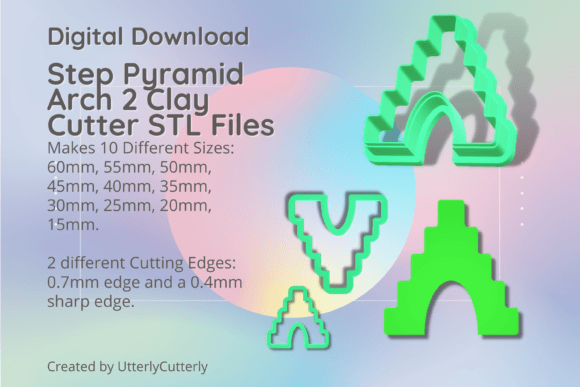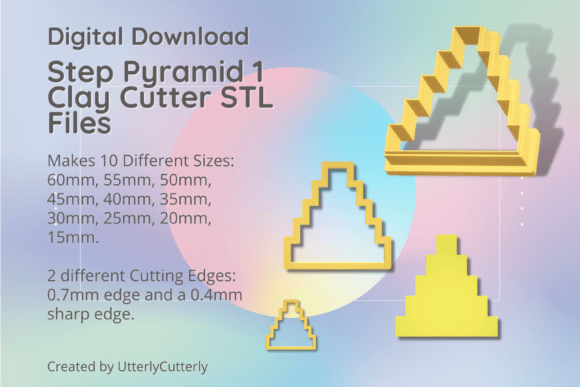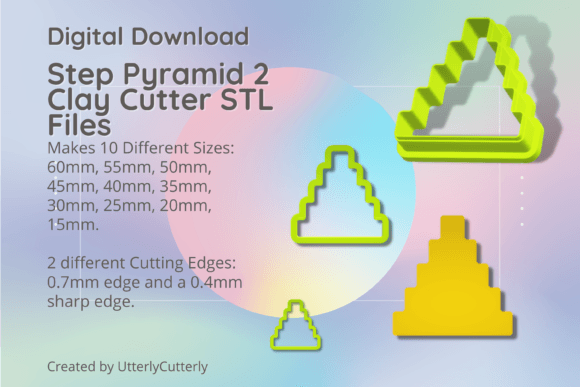
Step Pyramid Arch 1 Clay Cutter - Aztec: STL File Evaluation
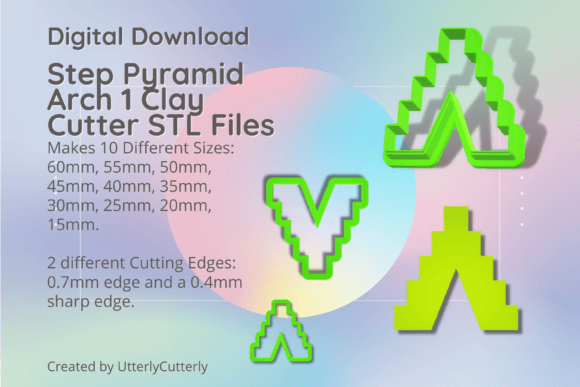
The Step Pyramid Arch 1 Clay Cutter - Aztec is a digital STL file bundle designed for creators who own 3D printers and wish to manufacture their own geometric shaping tools. This specific digital asset focuses on Mesoamerican-inspired architecture, translating the distinct silhouette of Aztec step pyramids into functional cutting edges. Unlike pre-manufactured metal or plastic cutters, this product provides the source data required to produce ten distinct sizes and two specialized edge profiles at home. For artisans working with polymer clay, ceramic clay, cookie dough, or fondant, understanding the technical specifications and practical applications of this digital download is essential for determining if it aligns with current production needs.
Design Versatility and Application Scope
The primary value proposition of the Step Pyramid Arch 1 Clay Cutter - Aztec lies in its geometric precision and scalability. The design captures the tiered structure typical of Aztec architecture, offering a stylized arch that serves multiple creative disciplines. Because the files are digital, the user is not limited to a single scale. The inclusion of sizes ranging from 15mm to 60mm allows for significant versatility across different mediums.
For jewelry makers, the smaller increments (15mm through 30mm) are optimized for creating lightweight polymer clay earrings, pendants, and charms. These dimensions ensure the final pieces remain wearable without excessive bulk. Conversely, the larger sizes (35mm through 60mm) cater to hair accessories like barrettes, as well as culinary applications such as cookies and fondant decorations. The ability to print matching sets across these size ranges enables creators to curate cohesive collections or offer coordinated product lines without sourcing multiple physical tools from different vendors.
Evaluating Edge Profiles: Standard vs. Sharp Edge
A critical decision point when utilizing this STL bundle is selecting the appropriate cutter profile for the intended material. The pack includes two distinct variations, each engineered for specific performance characteristics.
Standard 0.7mm Wall Profile
The standard version features a 0.7mm wall thickness with a 3mm thick base and a total height of 12mm. This profile offers increased structural rigidity during the printing process and subsequent use. It is generally more forgiving for users with entry-level FDM printers that may struggle with extremely thin walls. This variation is suitable for softer materials like fondant, cookie dough, or softer polymer clays where extreme sharpness is less critical than durability. The thicker wall also reduces the risk of the cutter deforming under pressure during repetitive use.
Sharp Edge (SE) Profile
The Sharp Edge variant, abbreviated as SE in the file names, utilizes a 1mm support wall tapering to a 0.4mm cutting edge. Like the standard version, it maintains a 3mm base and 12mm height. This profile is specifically engineered for clean cuts in polymer clay and ceramic materials where crisp definition is paramount. The reduced contact area at the cutting edge minimizes drag and distortion, preserving the intricate stepped details of the Aztec arch design. However, this profile requires precise printer calibration. Users must evaluate their machine’s ability to reliably print 0.4mm features before committing to this variation, as layer adhesion issues can compromise the tool's integrity.
Technical Considerations for Embossing and Printing
Beyond simple cutting, some designs in this category include embossing lines intended to add surface texture. It is important to note that these embossing features are 10.5mm tall. Consequently, they will only function effectively on clay slabs thicker than 1.5mm. Attempting to use the embossing feature on thinner sheets will result in cutting through the material rather than impressing a texture. Creators should measure their conditioned clay slabs carefully before attempting textured impressions to avoid wasting material.
Printability is another factor requiring objective assessment. While these files are designed to be easily printed, success depends heavily on hardware capabilities. A 0.4mm nozzle is typically recommended for the SE files, while a 0.6mm nozzle may suffice for the standard 0.7mm walls. Bed adhesion is crucial given the relatively small footprint of the 15mm and 20mm cutters; using a brim or raft may be necessary to prevent warping or detachment during printing. Users should anticipate some post-processing, such as sanding the cutting edge or removing support artifacts, to achieve professional-grade results.
Digital Assets vs. Physical Alternatives
When evaluating the Step Pyramid Arch 1 Clay Cutter - Aztec, buyers must weigh the benefits of digital ownership against the convenience of physical products. Digital STL files offer unmatched customization and cost-efficiency over time. Once purchased, the marginal cost of producing additional cutters is merely filament and electricity. If a cutter breaks or wears out, it can be replaced instantly without shipping delays. Furthermore, having the source files allows users to modify designs or combine them with other STL assets to create unique hybrid tools.
However, physical cutters remain a viable alternative for those without 3D printing infrastructure or the time investment required for prototyping. Metal cutters often provide superior longevity and consistent sharpness without the layer lines inherent to FDM printing. Resin-printed cutters offer higher resolution than FDM but require safety precautions regarding resin handling and curing. The decision ultimately rests on whether the user values immediate readiness and industrial finish (physical) versus long-term flexibility and self-sufficiency (digital).
Determining Fit for Creative Workflows
This STL bundle is a strong fit for makers who have already established a 3D printing workflow and require niche, culturally inspired geometric shapes that are difficult to find in mass-market catalogs. It is particularly valuable for sellers on platforms like Etsy who need to differentiate their offerings through proprietary tooling. The weekly release schedule of new STL files from this vendor also suggests an ecosystem approach, where this Aztec arch pack can be integrated with future releases to build a comprehensive library of complementary shapes.
Conversely, this product may not align with the goals of hobbyists seeking a one-time purchase for occasional use, or professionals requiring food-safe certified tools. Standard 3D printing filaments like PLA are not inherently food-safe due to layer line bacteria retention and potential nozzle contamination. While excellent for clay crafts, users intending to use these for commercial food production must implement appropriate food-safety protocols, such as single-use barriers or specialized food-safe printing setups. Understanding these limitations ensures that the Step Pyramid Arch 1 Clay Cutter - Aztec serves as an effective solution within its intended scope rather than a misapplied resource.