Mirror Shape 1 Clay Cutter - STL Digital: Technical Specifications and Practical Applications
The Mirror Shape 1 Clay Cutter - STL Digital represents a specific category of additive manufacturing assets designed for artisans working with polymer clay, ceramic dough, and cookie mediums. Unlike physical tools shipped from a manufacturer, this product is a digital bundle containing stereolithography (STL) files that allow users to fabricate their own cutting tools on demand. The distinct value proposition of this digital format lies in its versatility; rather than purchasing a single fixed-size tool, the user gains access to a comprehensive size gradient and dual-edge profiles. This approach shifts the evaluation criteria from simple aesthetic preference to technical compatibility with one's 3D printing capabilities and specific crafting requirements.
When evaluating the Mirror Shape 1 Clay Cutter against traditional metal cutters or pre-printed plastic alternatives, the primary differentiator is customization through iteration. Physical tools are static; if a 50mm cutter proves too large for a specific earring design, the artisan must purchase a new tool. With this STL bundle, the transition between sizes is instantaneous and cost-free after the initial acquisition. However, this flexibility introduces variables regarding print quality, material choice, and post-processing that do not exist with stamped steel options. Understanding these tradeoffs is essential for determining whether a digital workflow aligns with your production needs.
Evaluating Edge Profiles: Sharp vs. Standard Wall Thickness
A critical decision factor when utilizing the Mirror Shape 1 Clay Cutter - STL Digital is selecting the appropriate edge profile for the intended medium. The bundle includes two distinct cutter types, each engineered for different mechanical interactions with soft materials. Making the wrong selection can lead to torn clay edges, excessive sticking, or fragile printed parts.
The Standard 0.7mm Wall Profile
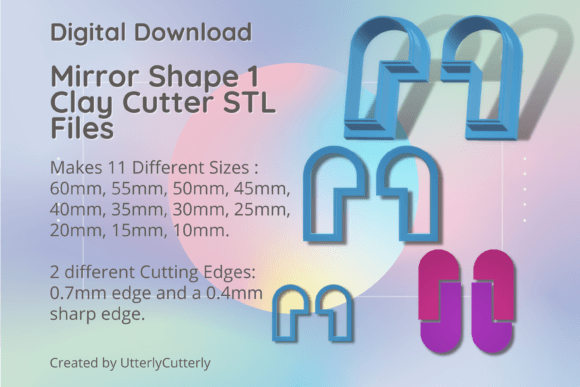
The standard version features a 0.7mm wall thickness with a 3mm thick base and a total height of 12mm. This specification prioritizes structural integrity and ease of printing over surgical precision. For users with entry-level FDM printers or those using abrasive clay bodies containing grog or sand, this thicker wall reduces the risk of nozzle clogs and layer separation during the print process. It is generally the superior choice for cookie cutters or thicker ceramic slabs where extreme edge definition is less critical than tool durability. The 0.7mm edge provides enough surface area to prevent the cutter from slicing through the clay too aggressively, which helps maintain the shape during the lifting phase.
The Sharp Edge (SE) Profile
Abbreviated as SE in the file directory, the Sharp Edge variant utilizes a 1mm support wall tapering to a 0.4mm cutting edge. While still maintaining the 3mm base and 12mm height, this geometry is optimized for polymer clay jewelry and detailed biscuit work. The reduced contact area at the cutting interface minimizes friction and drag, resulting in cleaner release and sharper definitions. However, this profile demands higher printer calibration. A 0.4mm cutting edge is essentially a single nozzle width on many standard machines; any flow rate inconsistency or bed adhesion failure will compromise the tool. Users should reserve the SE files for well-tuned printers and non-abrasive media to maximize the lifespan of the cutter.
Size Gradients and Scaled Production Workflows
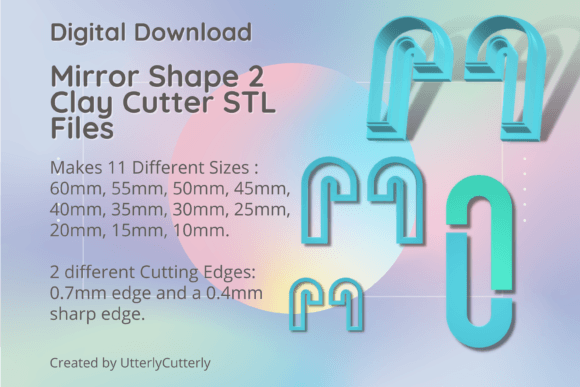
The inclusion of eleven discrete sizes—ranging from 10mm to 60mm in 5mm increments—addresses a common limitation in both physical and digital tool markets: the lack of proportional scaling. Many cutter sets offer only "small," "medium," and "large," leaving significant gaps in sizing. The Mirror Shape 1 Clay Cutter - STL Digital eliminates this ambiguity by providing precise measurements taken from the longest ends of the shape.
This granular sizing supports several practical workflows:
- Nesting Designs: Jewelry makers can create graduated sets of earrings or pendants without manually resizing files in CAD software, which often distorts aspect ratios or alters wall thicknesses unpredictably.
- Material Conservation: When working with expensive precious metal clays or specialized polymer blends, having exact size options allows artisans to select the smallest viable cutter, reducing waste and scrap reprocessing time.
- Batch Consistency: For sellers fulfilling custom orders, the ability to print identical replacement tools ensures that a "40mm mirror" produced today matches one produced six months ago, mitigating variance caused by worn metal molds or inconsistent hand-cutting.
It is important to note that while digital files are scalable in slicer software, doing so changes the wall thickness proportionally. Scaling a 60mm file down to 30mm may result in walls too thin to print reliably. The pre-sized files in this bundle maintain optimal engineering tolerances across the entire range, a significant advantage over manual rescaling.
Embossing Compatibility and Depth Management
For users incorporating texture into their work, the bundle notes that embossing lines are 10.5mm tall. This specification dictates a minimum clay thickness of 1.5mm to function correctly. If the clay slab is thinner than this threshold, the embosser will bottom out, potentially tearing the material or failing to transfer the design. Conversely, this depth is shallower than some heavy-duty industrial embossers, making it safer for delicate jewelry applications where deep impressions might weaken the structural integrity of the final piece. Always measure your conditioned clay slab height before selecting an embossing-capable cutter to ensure clean results.
Digital vs. Physical: Assessing Fit and Limitations
While the Mirror Shape 1 Clay Cutter - STL Digital offers significant advantages in variety and cost-per-unit, it is not universally superior to physical alternatives. A balanced evaluation requires acknowledging scenarios where other options may be preferable.
When Digital STL Files Are the Right Choice
This digital bundle is best suited for makers who already possess a reliable 3D printing setup and require frequent variation in size or style. It is ideal for prototyping new product lines where committing to expensive custom metal dies is financially unjustifiable. Additionally, because new STL files are added to the store weekly, users invested in this ecosystem can continuously expand their library without accumulating physical storage clutter. The ability to curate custom combos with other digital assets creates a cohesive toolkit that evolves with the maker’s business.
When to Consider Alternatives
If you lack access to a 3D printer or have no interest in learning printer maintenance, physical cutters remain the more practical option. The upfront time investment for printing, cleaning supports, and sanding edges can exceed the time saved by digital customization for low-volume hobbyists. Furthermore, for high-pressure commercial bakery environments involving thousands of cycles per day, food-grade stainless steel offers longevity and sanitation compliance that PLA or PETG prints cannot match. Digital cutters excel in bespoke, small-batch, and artistic contexts but face limitations in industrial throughput and regulatory compliance for direct food contact.
Technical Considerations for Successful Fabrication
To derive maximum value from the Mirror Shape 1 Clay Cutter - STL Digital, users must treat the printing process as part of the tool-making craft. The files are tested and designed for printability, but success depends on local machine conditions.
- Orientation: Print cutters with the cutting edge facing up to avoid support structures touching the functional surface. Supports should only touch the base plate.
- Material Selection: PLA is sufficient for most polymer clay work due to its rigidity and ease of printing. PETG or ABS may be preferred for ceramic clay due to higher heat resistance and flexibility, though they require more advanced tuning.
- Post-Processing: Even with perfect layer adhesion, FDM prints may have microscopic ridges. Light sanding of the cutting edge with high-grit paper (600+) significantly improves release properties and finish quality on raw clay.
- Safety and Hygiene: As this is a digital download for self-fabrication, the end-user assumes responsibility for material safety. Ensure filaments used for food-related applications are certified food-safe and understand that 3D printed layers can harbor bacteria regardless of material certification.
Ultimately, the Mirror Shape 1 Clay Cutter - STL Digital serves as a bridge between digital design flexibility and tactile craftsmanship. By offering dual edge profiles and a complete size spectrum, it accommodates a wide range of skill levels and project types. Success depends less on the file itself and more on the user’s willingness to integrate digital fabrication into their broader creative workflow. For those prepared to manage the technical aspects of 3D printing, this bundle provides a scalable foundation for unique, consistent, and customizable tool creation.