Flower 17 Clay Cutter STL: Technical Specifications and Practical Application
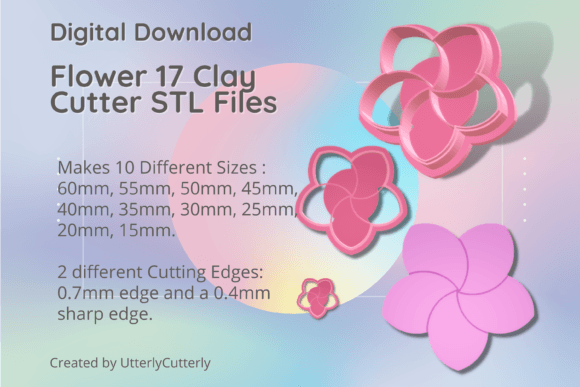
The Flower 17 Clay Cutter - STL Digital File represents a functional asset for makers utilizing additive manufacturing to produce custom tools. Unlike generic marketplace listings, this digital download provides specific engineering parameters designed for polymer clay and cookie dough applications. For professionals and serious hobbyists, the value of an STL file lies not merely in the aesthetic shape but in the printability, dimensional accuracy, and edge geometry encoded within the mesh. This particular bundle offers a comprehensive range of ten distinct sizes and two specialized cutting edge profiles, addressing the variable needs of jewelry fabrication and culinary arts without requiring manual CAD adjustments.
Evaluating Printability and Edge Geometry
When assessing digital cutter files, the primary concern is often how well the design translates from screen to physical object. The Flower 17 Clay Cutter - STL Digital File mitigates common printing failures through two distinct structural configurations. Understanding these variations is essential for selecting the correct file for your specific material and printer capabilities.
Standard Wall Configuration
The first option features a 0.7mm wall thickness with a 3mm thick base and a total height of 12mm. This geometry is optimized for standard FDM printers using 0.4mm nozzles. The 0.7mm wall typically prints as two perimeters, providing sufficient rigidity to prevent warping during the cooling phase while maintaining enough flexibility to release clay without tearing. The reinforced 3mm base serves as a stabilizer, ensuring the cutter remains perpendicular to the work surface during use. This version is generally recommended for softer polymer clays or when durability is prioritized over extreme precision.
Sharp Edge (SE) Variant
For users requiring cleaner cuts and higher definition, the Sharp Edge variant—abbreviated as SE in the file set—offers a refined geometry. It utilizes a 1mm support wall transitioning into a 0.4mm cutting edge. While more challenging to print, this profile significantly reduces drag on the clay, resulting in less distortion upon removal. The 0.4mm tip approaches the limit of standard extrusion width, meaning successful printing requires precise flow rate calibration and adequate part cooling. This variant is particularly valuable for detailed jewelry components where post-processing cleanup time must be minimized.
Dimensional Versatility and Sizing Logic
A significant advantage of this digital bundle is the inclusion of ten graduated sizes. In professional workflows, having a nested set of cutters allows for rapid prototyping and consistent scaling across product lines. The sizes included in this pack are measured from the longest ends: 60mm, 55mm, 50mm, 45mm, 40mm, 35mm, 30mm, 25mm, 20mm, and 15mm.
This 5mm increment between larger sizes and tighter spacing at smaller scales reflects practical usage patterns. Larger cutters are often used for statement pieces or cookies where size differentiation is visually obvious. Smaller cutters, frequently used for earring charms or intricate garnishes, require finer gradations to allow for subtle design variations. Because cutter size is measured from the longest points, users should account for aspect ratio when planning designs; a 30mm flower cutter may have a narrower width depending on the petal orientation. This standardized sizing system also facilitates integration with other STL files from the same ecosystem, allowing creators to curate custom combo packs that maintain proportional harmony.
Embossing Integration and Material Thickness
Beyond simple outline cutting, the Flower 17 Clay Cutter - STL Digital File incorporates embossing functionality. Embossing lines within the model are set at a height of 10.5mm relative to the base. This specification dictates a critical operational constraint: the clay or dough must be thicker than 1.5mm to accommodate the relief without bottoming out.
If the material is rolled thinner than 1.5mm, the embossing detail will press completely through or fail to register clearly. For jewelry makers working with precious metal clay or thin polymer sheets, this necessitates careful slab preparation. Conversely, for cookie decorators using royal icing foundations, this depth provides ample clearance for textured surfaces. Users should verify their rolling pin guides or pasta machine settings against this 1.5mm threshold before beginning production to avoid wasted material and print time.
Workflow Integration for Makers and Small Businesses
Digital assets like this bundle serve different strategic purposes depending on the user's role. For small business owners selling physical goods, the ability to print replacement cutters on-demand eliminates supply chain dependencies. If a cutter breaks or wears down, a new one can be produced in under an hour. For educators and workshop leaders, the digital format allows for instant distribution to students who own printers, reducing overhead costs associated with physical tool kits.
Freelancers and content creators benefit from the iterative nature of STL files. Testing the Flower 17 Clay Cutter - STL Digital File across different clay brands reveals how material elasticity interacts with the 0.7mm versus SE edge profiles. Documenting these interactions adds value to tutorials and reviews. Furthermore, because new STL files are added to the store weekly, maintaining a digital library allows for continuous collection expansion without accumulating physical storage clutter.
Technical Considerations and Limitations
While the design is tested and optimized, users must recognize inherent limitations of FDM printing for fine details. The Sharp Edge variant, despite its utility, is susceptible to layer adhesion issues if printed too fast. It is advisable to reduce print speeds for the outer walls and increase fan speed to solidify the thin cutting tip rapidly. Additionally, bed leveling must be precise; an uneven first layer can render the 0.4mm edge useless or cause the nozzle to scrape the build plate.
Material choice also impacts performance. PLA is standard for clay cutters due to its stiffness and low shrinkage, but it can become brittle over time. PETG offers better longevity and chemical resistance but may exhibit stringing that interferes with delicate embossing lines. ABS or ASA are generally unnecessary for this application and introduce warping risks that could distort the 10-size gradient set. Always perform a test print with the smallest size (15mm) before committing to the full suite to validate dimensional accuracy and edge quality.
Assessing Value and Long-Term Utility
The decision to acquire the Flower 17 Clay Cutter - STL Digital File should be based on workflow compatibility rather than novelty. For users without a 3D printer, this product offers no immediate utility. However, for those with established printing capabilities, the cost-per-cutter drops significantly compared to purchasing physical equivalents. The inclusion of both robust and sharp-edge variants doubles the functional lifespan of the purchase, as users can switch profiles based on project requirements without seeking additional files.
Quality assurance is evident in the tested nature of these files. Many free or low-cost STL repositories contain non-manifold geometry or unprintable overhangs that waste filament and time. This bundle’s adherence to specific wall thicknesses and base reinforcements suggests a design process grounded in manufacturing reality rather than purely artistic modeling. For professionals evaluating digital tools, this reliability is often worth more than the initial download price.
Ultimately, this digital asset fits best within a mature maker workflow where customization, scalability, and self-sufficiency are priorities. Whether producing consistent jewelry collections or scalable cookie designs, the technical specifications provided here offer a reliable foundation for creative production. Users should approach this file as a component of a broader digital fabrication strategy, leveraging its modularity to enhance efficiency and maintain quality standards across diverse projects.