Moon Bloom 1 Clay Cutter - Celestial STL: Evaluating Digital Design Specs and Material Compatibility
Selecting the right digital assets for polymer clay or culinary applications requires a detailed understanding of file specifications, printability, and material interaction. The Moon Bloom 1 Clay Cutter - Celestial STL represents a specific category of functional 3D printing files designed for makers who require precision across multiple scales. Unlike physical tools shipped from a manufacturer, this digital download places the responsibility of production quality on the user’s printer calibration and material choices. Understanding the technical distinctions between the included cutter variations is essential for determining whether this bundle aligns with your current fabrication capabilities and project requirements.
Distinguishing Edge Profiles: Standard vs. Sharp Edge Variants
The primary decision factor when utilizing the Moon Bloom 1 Clay Cutter - Celestial STL bundle is selecting the appropriate edge profile for your specific medium. This pack includes two distinct cutting edge geometries, each engineered for different performance characteristics. Recognizing the tradeoffs between these profiles prevents material waste and ensures cleaner results.
The 0.7mm Wall Profile
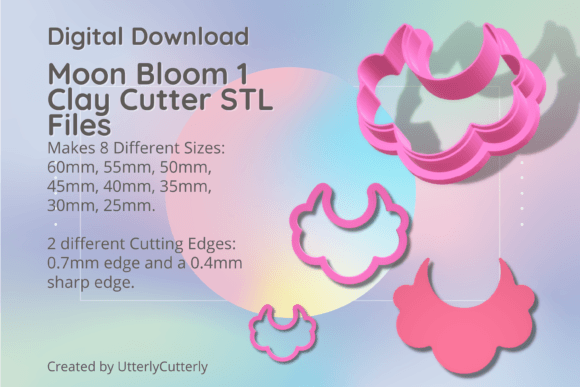
The standard cutter in this set features a 0.7mm wall thickness with a matching cutting edge. Structurally, this design offers superior rigidity during the printing process and subsequent use. For makers using FDM printers with standard 0.4mm nozzles, this wall thickness is generally more forgiving regarding flow rate inconsistencies and layer adhesion. It provides a sturdy base that resists deformation when pressing into denser materials like cold porcelain or firm polymer clay. However, the thicker edge leaves a slightly more rounded impression on soft mediums, which may require additional hand-finishing if a crisp silhouette is desired.
The Sharp Edge (SE) Variant
Labeled as "SE" in the file directory, the Sharp Edge variant utilizes a 1mm support wall tapering to a 0.4mm cutting edge. This geometry is specifically intended for achieving clean cuts in softer media such as fondant, gum paste, or conditioned polymer clay without dragging. The reduced contact area minimizes friction, allowing the tool to glide through material rather than compressing it. Users should note that printing a 0.4mm functional edge requires precise extrusion calibration; under-extrusion can lead to fragile edges that snap during use, while over-extrusion may negate the sharpness advantage. This variant is best suited for experienced operators who have dialed in their printer settings for fine detail work.
Size Versatility and Application-Specific Selection
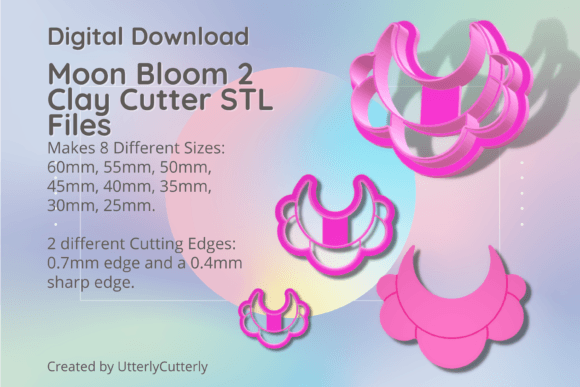
A significant advantage of the Moon Bloom 1 Clay Cutter - Celestial STL over fixed-size physical alternatives is the inclusion of eight incremental sizes ranging from 25mm to 60mm. This graduated sizing system allows for curated combinations that would be cost-prohibitive to purchase individually as physical tools. When evaluating which size to print, consider the end-use application rather than aesthetic preference alone.
- Jewelry Components (25mm – 35mm): These smaller diameters are optimized for earrings and pendants. At this scale, weight becomes a critical factor. The digital nature of the STL allows users to adjust infill density or wall counts in their slicer software to create lightweight jewelry components that remain comfortable for extended wear.
- Hair Accessories and Brooches (40mm – 50mm): Mid-range sizes provide sufficient surface area for barrettes and hair clips while maintaining structural integrity. These sizes balance visual impact with practical functionality, ensuring the piece does not become too heavy for standard hardware.
- Culinary and Large Decor (55mm – 60mm): The largest cutters in the bundle are typically reserved for cookies, fondant cake toppers, or statement art pieces. When printing at 60mm, ensure your build plate adhesion is optimal, as larger footprints increase the risk of warping on heated beds.
This modularity distinguishes the Moon Bloom 1 Clay Cutter - Celestial STL from single-purpose tools. Makers can prototype a design at 30mm to test fit and finish before committing to a full-scale 60mm print for a final product, reducing both filament waste and development time.
Technical Constraints and Embossing Considerations
While digital files offer flexibility, they also impose specific technical constraints that must be respected to achieve functional results. A critical specification for the Moon Bloom 1 Clay Cutter - Celestial STL involves the relationship between cutter height and embossing depth. All cutters in this bundle feature a total height of 12mm with a 3mm thick base. Crucially, any integrated embossing lines are designed at 10.5mm tall.
This dimensional relationship dictates a minimum material thickness. To utilize the embossing features effectively without bottoming out or distorting the clay, users must work with material thicker than 1.5mm. Attempting to use these cutters on thinly rolled sheets (e.g., 1mm pasta machine settings) will result in incomplete impressions or structural failure of the clay piece. Makers accustomed to working with very thin slabs may need to adjust their conditioning process or select alternative cutter designs with shallower relief depths. This limitation highlights the importance of reviewing STL specifications against established workflow habits before purchasing digital assets.
Comparing Digital STL Bundles to Physical Alternatives
Evaluating the Moon Bloom 1 Clay Cutter - Celestial STL requires comparing it against traditional metal or plastic cutters. Each format presents distinct benefits and limitations depending on the user's resources and priorities.
Customization vs. Convenience
Physical cutters offer immediate utility with guaranteed consistency. There is no learning curve regarding print orientation, support removal, or bed leveling. For high-volume commercial bakers or artists with tight turnaround times, physical tools often represent a lower-risk investment. Conversely, the STL format offers unmatched customization. If a specific size within the Moon Bloom 1 range proves too large for a particular earring hook, the user can scale the model by 90% in their slicer—a modification impossible with physical inventory. This adaptability makes the digital option superior for designers developing proprietary collections where unique sizing differentiates their brand.
Cost Efficiency Over Time
The initial cost of a 3D printer and filament exceeds that of a single clay cutter. However, for makers who regularly acquire new shapes, the marginal cost of producing additional cutters from the Moon Bloom 1 Clay Cutter - Celestial STL bundle approaches zero after the initial hardware investment. Physical specialty cutters can range significantly in price per unit, especially for niche celestial designs. Digital bundles amortize this cost across infinite reproductions and replacements. If a cutter breaks during use, a replacement can be printed in under an hour, eliminating downtime associated with shipping delays.
Material Safety and Food Contact
A vital consideration for culinary users is food safety. While the Moon Bloom 1 Clay Cutter - Celestial STL files themselves are inert data, the printed object's safety depends entirely on the filament used and post-processing methods. Standard PLA is generally considered food-safe in composition, but FDM printing creates micro-layer lines that can harbor bacteria. Physical stainless steel cutters do not share this porosity issue. Users intending to use these STL prints for cookies or fondant must implement appropriate sealing protocols or dedicate specific prints solely to food use, accepting the maintenance overhead as part of the digital fabrication tradeoff.
Determining Fit: When to Choose Digital Assets
The Moon Bloom 1 Clay Cutter - Celestial STL is best suited for makers who view tool creation as an extension of their artistic process. It serves those who value iterative design, possess calibrated equipment, and understand the mechanical properties of their printing setup. The inclusion of both robust and sharp-edge variants demonstrates an awareness of diverse material needs, making it a versatile resource for mixed-media artists.
However, this digital bundle may not be the optimal choice for beginners without 3D printing experience or those requiring certified food-safe tools without additional processing steps. Similarly, makers who prefer the tactile feedback of metal edges or lack the time to troubleshoot print failures may find greater value in traditional options. Ultimately, the decision hinges on whether the user prioritizes the autonomy and scalability of digital fabrication or the reliability and immediacy of manufactured goods. By carefully assessing these factors against the technical specifications outlined above, creators can make an informed choice that supports both their creative vision and operational efficiency.