Deco Earring 8 Clay Cutter - Earring STL: Evaluating Digital Versatility for Polymer Clay and Baking
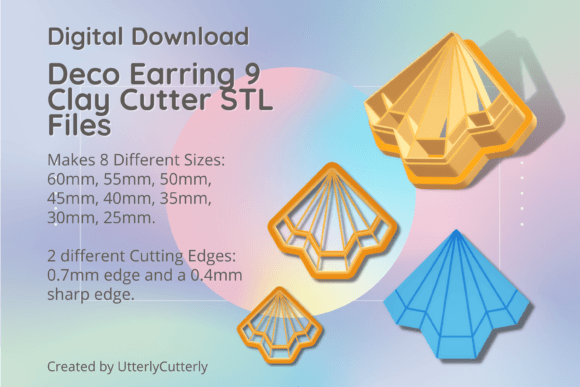
For makers utilizing 3D printing technology to create custom tools, the Deco Earring 8 Clay Cutter - Earring STL represents a specific category of digital fabrication assets designed for dual-purpose utility. Unlike physical cutters shipped from a manufacturer, this product is a digital download comprising STL files optimized for FDM (Fused Deposition Modeling) printers. The primary distinction of this bundle lies in its comprehensive sizing strategy and dual-edge architecture, addressing a common pain point in the maker community: the lack of scalable, consistent design geometry across different project types.
When evaluating this STL pack against standard single-size cutter files or pre-sliced commercial options, the value proposition shifts from immediate convenience to long-term production flexibility. This analysis explores the technical specifications, material applications, and decision factors necessary to determine if this digital asset aligns with your current workflow for jewelry making, fondant work, or general crafting.
Technical Specifications and Printability Assessment
The efficacy of any clay cutter STL depends entirely on how well the digital model translates to physical plastic. The Deco Earring 8 set is engineered with specific tolerances that differentiate it from generic free files often found on open repositories. Understanding these specifications is critical for successful printing and functional use.
Dual Edge Architecture
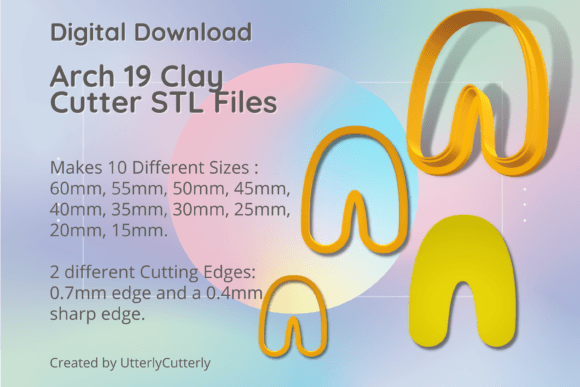
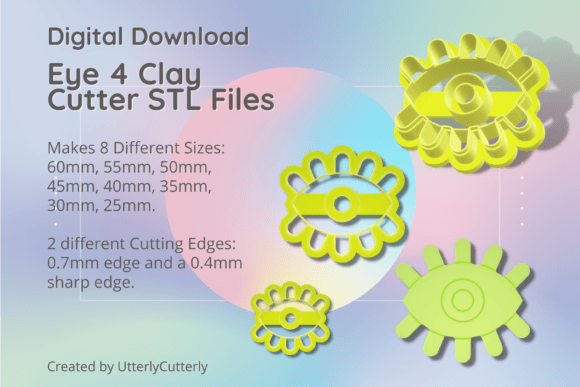
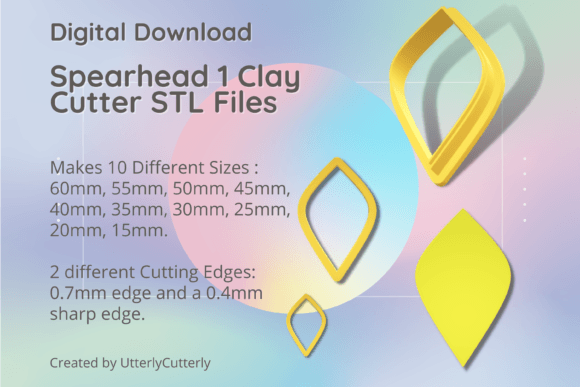
This bundle includes two distinct cutting edge profiles within the same geometric design. This duality allows users to select the appropriate tool based on the material's viscosity and the desired finish.
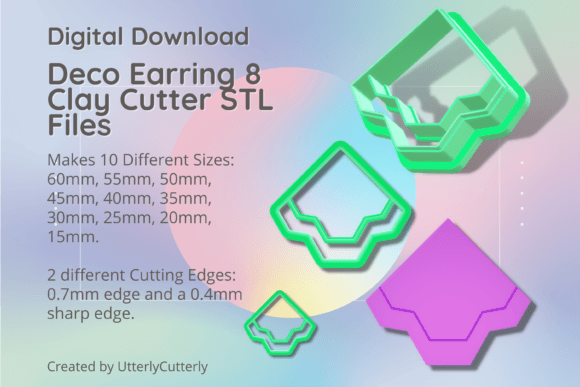
- Standard Edge: Features a 0.7mm wall thickness with a 3mm thick base and 12mm height. This profile offers structural rigidity, making it suitable for stiffer polymer clays or repetitive use where blade deformation is a concern. The thicker wall reduces the risk of the cutter warping during the print process or snapping under pressure.
- Sharp Edge (SE): Abbreviated as SE in the file names, this variant utilizes a 1mm support wall tapering to a 0.4mm cutting edge. It maintains the same 3mm base and 12mm height as the standard version. The reduced contact surface area allows for cleaner cuts in softer materials like fondant or conditioned polymer clay, minimizing drag and distortion.
Size Gradation and Scalability
A significant limitation of many standalone STL files is the inability to scale them without compromising wall integrity. Scaling a 0.4mm blade up by 200% results in a fragile 0.8mm blade that may not cut effectively, while scaling down can result in unprintable nozzles-sized gaps. The Deco Earring 8 Clay Cutter - Earring STL mitigates this by providing ten discrete, pre-calculated sizes: 60mm, 55mm, 50mm, 45mm, 40mm, 35mm, 30mm, 25mm, 20mm, and 15mm.
Cutter size is measured from the longest ends, ensuring predictable dimensions regardless of the shape's aspect ratio. This graduated approach allows crafters to create nested designs or proportionally matched earring and pendant sets without relying on slicer software scaling, which often introduces artifacts or weak layer adhesion.
Material Compatibility and Application Boundaries
While marketed primarily for earrings, the utility of this STL bundle extends across multiple mediums. However, performance varies significantly depending on the material properties. Makers should evaluate their primary medium before committing to this specific geometry.
Polymer Clay and Jewelry Making
This is the optimal use case for the Deco Earring 8 set. The 12mm height provides ample clearance for thumb placement, which is essential when applying even pressure to polymer clay. For users working with slab rollers or pasta machines, the consistent 3mm base thickness ensures the cutter sits flush against the work surface. If your workflow involves embossing, note that any embossing lines in this design are 10.5mm tall. Consequently, this tool requires clay sheets thicker than 1.5mm to function correctly; thinner sheets will bottom out before the embossing detail transfers effectively.
Fondant and Cookie Decoration
The Sharp Edge (SE) variant makes this STL viable for food-safe applications, provided the user employs food-safe filament and follows proper hygiene protocols. The 0.4mm edge is superior for fondant, as it severs sugar paste cleanly without tearing. For cookies, the Standard Edge is generally preferred. Cookie dough is denser and more abrasive than fondant; the 0.7mm wall resists wear better and is easier to clean thoroughly between uses. Users comparing this to dedicated cookie cutter STLs should note that 12mm is a relatively shallow height for thick gingerbread or shortbread. If you regularly bake cookies exceeding 1cm in thickness, you may need to modify the Z-height in your slicer or seek alternative files with taller walls.
Comparative Analysis: Digital STL vs. Physical Alternatives
Choosing between downloading the Deco Earring 8 Clay Cutter - Earring STL and purchasing physical cutters involves weighing upfront costs against long-term autonomy. Each option presents distinct tradeoffs.
Cost Efficiency and Volume
Physical arch cutters typically range from $3 to $8 per unit. Acquiring ten sizes in two edge variants physically would represent a significant investment. The digital bundle amortizes this cost instantly. For high-volume producers or those who frequently prototype new shapes, the marginal cost of printing an additional cutter is merely cents in filament and electricity. However, for hobbyists who only need one specific size for a singular project, the time and material cost of printing may exceed the price of a ready-made tool.
Customization and Repair
Digital files offer reparability that physical goods cannot. If a printed SE cutter breaks, you can reprint it immediately. Furthermore, owning the STL allows for post-processing modifications. Advanced users can import the Deco Earring 8 files into CAD software to add alignment holes, texture plates, or handle extensions. Physical cutters are static; if the design doesn't perfectly fit your ergonomic needs or aesthetic vision, you must find a different product.
Lead Time and Accessibility
The immediate availability of a digital download eliminates shipping delays. This is a decisive factor for makers working on tight deadlines or those in regions with limited access to specialized craft supplies. Conversely, physical cutters arrive ready-to-use with guaranteed quality control. Printing requires calibration, bed leveling, and potential troubleshooting. If your printer is not dialed in for small tolerances, the 0.4mm Sharp Edge may fail to print correctly, rendering the file useless until hardware issues are resolved.
Decision Factors: When to Choose This STL Bundle
The Deco Earring 8 Clay Cutter - Earring STL is not a universal solution. Based on technical constraints and user profiles, it fits specific scenarios better than others.
Ideal Fit Scenarios
- Multi-Scale Production: You create coordinated sets (e.g., stud earrings, dangle earrings, and pendants) requiring identical shapes at different scales.
- Material Experimentation: You switch between polymer clay and fondant and need interchangeable edge geometries without buying duplicate physical tools.
- Printer Owners with Calibration Experience: You have successfully printed 0.4mm walls previously and understand retraction settings to prevent stringing on fine details.
- Inventory Management: You have limited storage space and prefer storing gigabytes of designs over boxes of plastic tools.
Situations Requiring Alternatives
- Deep Embossing Needs: Your standard clay slab thickness is less than 1.5mm. The 10.5mm embossing depth in this file will be incompatible with thin-sheet workflows.
- Thick Dough Baking: You exclusively bake raised cookies or biscuits thicker than 12mm. The wall height will be insufficient to contain the dough.
- No 3D Printer Access: Without access to an FDM printer capable of 0.4mm nozzle resolution, this digital product has no utility. Resin printers are generally not recommended for these cutters due to brittleness and safety concerns regarding uncured resin residue.
- Immediate Single-Use Requirement: You need one specific size for a project starting today and lack the time to troubleshoot print failures.
Practical Considerations for Digital Acquisition
As this is a non-physical item, the acquisition process differs from traditional retail. Upon completion of the transaction, access to the files is granted via digital download. Users should verify their slicer software compatibility before purchase; while STL is a universal format, some proprietary ecosystems may require conversion. Additionally, because new STL files are added to the store weekly, this bundle should be viewed as part of a broader ecosystem. Evaluating whether the vendor’s design language remains consistent across releases is important for makers planning to curate a cohesive tool library over time.
Ultimately, the Deco Earring 8 Clay Cutter - Earring STL serves as a foundational asset for digitally-enabled makers. Its strength lies in the intersection of precision engineering and versatile application. By understanding the relationship between the 0.7mm and 0.4mm edge variants, respecting the 1.5mm minimum clay thickness for embossing, and leveraging the ten-size gradation system, users can maximize the return on this digital investment. Careful consideration of your specific material workflows and printing capabilities will determine whether this bundle enhances your creative output or if alternative solutions better serve your immediate needs.