Rounded 5 Pointed Star Clay Cutter - STL: A Practical Guide to Digital Files
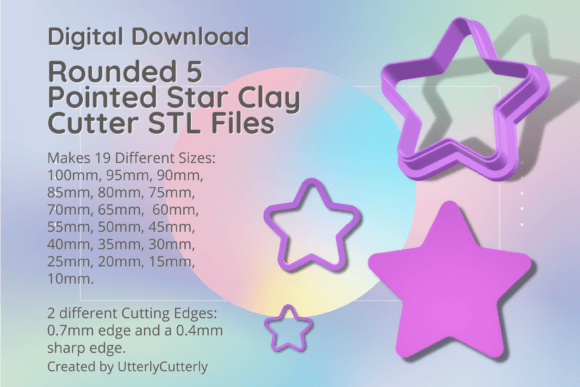
When you are curating a collection of polymer clay tools or expanding your cookie decorating inventory, the precision of your equipment dictates the quality of your final piece. The Rounded 5 Pointed Star Clay Cutter - STL is more than just a basic shape file; it is a comprehensive digital asset designed for makers who understand that versatility comes from having the right size and edge profile for specific tasks. This digital download provides a bundle of five round pointed star shape clay cutters in STL format, specifically engineered for easy printing and immediate use. However, owning the file is only the first step. Understanding how to select the correct variation from this extensive pack is what separates professional results from frustrating failures.
Understanding Edge Profiles and Material Compatibility
A frequent oversight when downloading cutter STL files is assuming all cutting edges perform identically across different mediums. This specific pack includes two distinct cutter types, and choosing the wrong one for your material can lead to tearing, dragging, or wasted clay. You must evaluate your primary medium before hitting print.
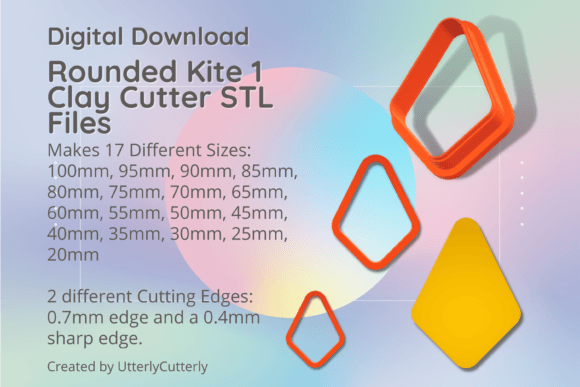
- The Standard Edge (0.7mm Wall): This version features a 0.7mm wall thickness with a 3mm thick base and a 12mm height. It is robust and durable, making it ideal for softer clays, fondant, or cookie dough where structural integrity of the cutter matters more than razor-sharp precision. If you are a beginner or working with materials that tend to stick, this is often the safer starting point.
- The Sharp Edge (SE): Abbreviated as SE in the file names, this variant has a 1mm support wall but tapers to a precise 0.4mm cutting edge. Like the standard version, it maintains a 3mm thick base and 12mm height. This is the superior choice for firm polymer clay or detailed jewelry work where clean lines are non-negotiable. Using the SE version on sticky dough without proper chilling may cause drag, while using the standard 0.7mm version on hard clay might result in deformation rather than a clean cut.
Misunderstanding these profiles is a common source of dissatisfaction. Makers often print the standard edge expecting jewelry-grade crispness, or they print the SE edge and struggle with soft dough. Always match the file suffix to your current project requirements.
Navigating Size Selections Without Guesswork
This bundle offers an impressive range of 19 different sizes, measured from the longest ends of the star points. The available dimensions span from 10mm up to 100mm in 5mm increments (100mm, 95mm, 90mm, 85mm, 80mm, 75mm, 70mm, 65mm, 60mm, 55mm, 50mm, 45mm, 40mm, 35mm, 30mm, 25mm, 20mm, 15mm, and 10mm). While having options is beneficial, printing every single size "just in case" is an inefficient use of filament and time.
A better approach is to audit your existing toolkit first. Many creators overlook the fact that cutter size interacts directly with shrinkage rates in polymer clay and spread in baking. If you need a finished 40mm star earring after baking, printing the 40mm cutter will likely result in a piece that is too small due to clay shrinkage. Experienced makers keep a shrinkage chart handy and select the next size up in the STL bundle to compensate. For cookies, consider that dough spreads outward; selecting a slightly smaller cutter than your target decoration area ensures the baked good fits within glaze boundaries. Curating custom combos becomes significantly easier when you treat these 19 sizes as a calibrated system rather than random shapes.
Critical Considerations for Embossing and Clay Thickness
If you intend to use these stars for textured jewelry or embossed cookies, pay close attention to the Z-axis specifications. Any embossing lines included in these designs are exactly 10.5mm tall. This measurement is not arbitrary; it is a functional constraint.
You must condition your clay to be thicker than 1.5mm before attempting to use the embossing feature. If your clay slab is thinner than this threshold, the cutter will bottom out against your work surface before the texture fully transfers, resulting in muddy details or incomplete impressions. Conversely, if your clay is excessively thick, the excess material may push up into the cutter cavity, making removal difficult and potentially distorting the star shape upon release. Investing in adjustable rolling pin guides or slats set to 2mm or 3mm ensures consistent results that align perfectly with the tool’s engineering. Ignoring this thickness requirement is the most common reason makers believe a digital file is defective when the issue is actually preparation.
Optimizing Print Settings for Functional Tools
Because these are digital STL files, the quality of the physical tool depends entirely on your printer settings. These cutters are designed to be easily printed, but "easy" does not mean "default." Printing with low infill or insufficient perimeters to save time will create brittle tools that snap under pressure, especially at the delicate star points.
For both the 0.7mm and SE variations, prioritize strength over speed. Use at least three to four perimeter walls to ensure the cutting edge remains rigid during use. The 3mm thick base is designed to provide comfort and leverage; printing with fewer top/bottom layers can compromise this ergonomic feature, making the cutter uncomfortable to press into resistant materials. Additionally, verify your bed adhesion. Stars have multiple contact points with sharp angles, which can be prone to lifting. A brim is often unnecessary given the 3mm base width, but ensuring a perfectly level bed is mandatory to prevent warped bottoms that won't cut evenly.
Managing Digital Assets and Future Expansion
Please remember that this is not a physical item. You will have access to download the files immediately after purchase, which means organization starts the moment you click the link. Create a dedicated folder structure on your computer categorized by shape, size, and edge type before downloading. Renaming files upon download to include key specs (e.g., "Star_Rounded_SE_50mm") prevents future confusion when you have hundreds of STLs in your library.
Furthermore, consider this bundle as part of a growing ecosystem. New STL files are added to the store every week, allowing you to expand your collection systematically. When evaluating future purchases, look for design consistency. These rounded 5-pointed stars are designed to coordinate with other shapes in the catalog, enabling you to build cohesive product lines for your business or hobby. By understanding the technical specifications and practical applications outlined above, you ensure that every file you download translates into a reliable, high-quality tool that enhances your creative workflow rather than complicating it.