Rounded Kite 1 Clay Cutter: Digital STL Files
Achieving consistent, professional shapes in polymer clay, cookie dough, or fondant often comes down to the precision of your tools. The Rounded Kite 1 Clay Cutter - Diamond Bas digital collection addresses this need by providing immediate access to a comprehensive suite of geometric cutters. Rather than waiting for shipping or settling for limited local inventory, creators with 3D printers can download these STL files and produce exactly what they need on demand. This digital approach shifts the focus from acquiring tools to curating a personalized workshop library that evolves alongside your creative projects.
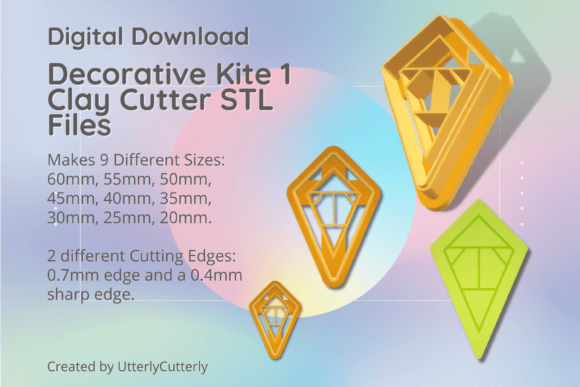
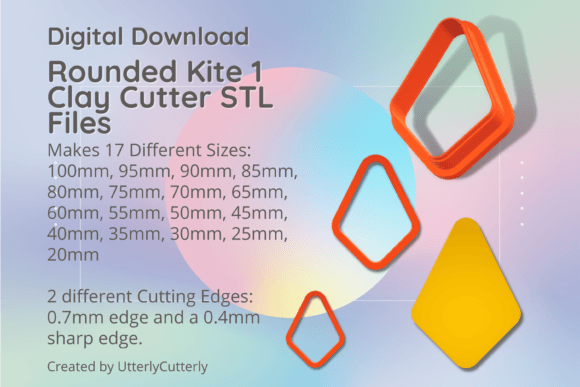
This specific bundle focuses on the versatile rounded kite diamond shape, a geometry that bridges the gap between soft organic curves and structured elegance. Whether you are designing statement earrings, architectural pendants, hair barrettes, or decorative baked goods, having seventeen distinct sizes at your disposal allows for nuanced design decisions. The ability to print these tools locally means you can test a size, realize it needs to be five millimeters larger for better visual balance, and have the corrected tool ready in minutes rather than days.
Selecting the Right Edge Profile for Your Material
One of the most significant advantages of this digital pack is the inclusion of two distinct cutting edge profiles within the same size range. Understanding when to use each type is essential for optimizing your results and reducing post-processing time. The files are categorized to help you make informed choices based on the material density and the desired finish.
The Standard 0.7mm Wall
The standard cutter features a 0.7mm wall thickness, a 3mm thick base, and a total height of 12mm. This profile is engineered for durability and ease of handling. It is particularly well-suited for:
- Polymer Clay Conditioning: When working with firmer clays or cold conditioning, the slightly thicker wall provides rigidity that prevents the cutter from flexing or deforming during pressure application.
- Cookies and Biscuits: Dough requires a sturdy edge to cut through without dragging. The 0.7mm wall offers enough surface area to push through dense dough cleanly while maintaining structural integrity over repeated uses.
- Fondant and Gum Paste: For cake decorators, this edge provides a clean release without sticking excessively to sugary mediums.
- Beginner Printing: If you are new to printing small functional parts, the 0.7mm wall is more forgiving regarding nozzle calibration and flow rate inconsistencies.
The Sharp Edge (SE) Variant
Files abbreviated as "SE" in the download feature a specialized geometry designed for precision. These cutters maintain the same 3mm base and 12mm height but utilize a 1mm support wall tapering to a 0.4mm cutting edge. This configuration serves specific high-detail applications:
- Delicate Jewelry Components: When making miniature earrings or intricate pendant layers, the sharper edge reduces clay displacement. This results in cleaner edges that require minimal sanding or trimming after baking.
- Soft Clays: Softer polymer clay brands tend to stick to wider walls. The reduced contact surface of the SE variant helps mitigate sticking issues.
- Crisp Definition: For designs where the silhouette must be exact, the 0.4mm edge slices rather than compresses, preserving the intended geometry of the Rounded Kite 1 design.
When printing the Sharp Edge variants, ensure your printer is properly calibrated. A 0.4mm cutting edge typically requires a 0.4mm nozzle with tuned retraction settings to prevent blobbing at the tip. If your prints are failing at the edge, consider adjusting your cooling fan speed or reverting to the standard 0.7mm version for that specific size.
Strategic Sizing for Cohesive Collections
Creative professionals understand that individual pieces rarely exist in isolation; they are part of a collection. The Rounded Kite 1 Clay Cutter bundle supports this workflow by offering seventeen graduated sizes ranging from 20mm to 100mm. Sizes include 20mm, 25mm, 30mm, 35mm, 40mm, 45mm, 50mm, 55mm, 60mm, 65mm, 70mm, 75mm, 80mm, 85mm, 90mm, 95mm, and 100mm.
Note that cutter size is measured from the longest ends of the diamond shape. This measurement standard is crucial for planning. A 50mm kite cutter will have a different visual weight than a 50mm circle cutter due to the elongated proportions. Having 5mm increments across such a wide range allows for precise scaling. For example, if you are creating a nested pendant set, you might select the 60mm, 45mm, and 30mm cutters to create perfectly proportioned layers with consistent negative space margins.
This granular sizing also benefits educators and workshop leaders who need to accommodate different skill levels or project scopes. Smaller sizes like 20mm and 25mm are ideal for charm-making classes or children’s workshops where fine motor skills are still developing, while the 80mm to 100mm range serves advanced students creating large-scale sculptural jewelry or home decor items.
Technical Considerations for Embossing and Depth
Beyond simple outline cutting, some users may wish to incorporate texture or depth. If utilizing embossing lines compatible with this system, be aware that they are designed with a height of 10.5mm. This specification dictates your material preparation. To achieve a clear impression without bottoming out or distorting the clay, you must work with material thicker than 1.5mm.
This technical constraint highlights the importance of using slat rollers or pasta machines set to specific thicknesses before cutting. Attempting to emboss into 1mm clay with a 10.5mm tall feature will result in structural failure of the piece. By adhering to the >1.5mm guideline, you ensure the clay has sufficient mass to accept the texture while maintaining the integrity of the Rounded Kite 1 silhouette. This level of technical detail in the file design reflects an understanding of actual crafting workflows, distinguishing these files from generic geometric shapes found on open repositories.
Optimizing Your 3D Printing Workflow
Since this is a digital download and not a physical item, the quality of your final tool depends entirely on your print settings. These STL files are designed to be easily printed, but optimal results require attention to orientation and adhesion.
Always print these cutters with the cutting edge facing up and the flat base against the build plate. This orientation eliminates the need for supports inside the cutting cavity, which are nearly impossible to remove cleanly from small tools. Use a brim if you are printing the smaller sizes (20mm–35mm) to prevent warping or detachment during the print. PLA is generally sufficient for polymer clay and fondant, but if you plan to use these cutters for hot cookies or require dishwasher safety, consider PETG or food-safe certified filaments.
The 3mm thick base included in both cutter types serves a dual purpose: it provides a comfortable grip for hand pressure and creates a stable foundation for first-layer adhesion. Avoid using excessive elephant foot compensation, as this can alter the critical dimensions of the cutting edge. Instead, rely on proper bed leveling and Z-offset calibration to ensure the base prints accurately.
Expanding Your Creative Toolkit
The Rounded Kite 1 Clay Cutter - Diamond Bas is designed to integrate seamlessly with other digital assets. Because the sizing follows a standardized metric progression, you can confidently mix these kite shapes with circles, arches, or organic forms from other packs in the store. New STL files are added weekly, allowing you to continuously expand your capabilities without accumulating physical storage clutter.
For entrepreneurs and small business owners, this digital model offers significant economic advantages. There is no minimum order quantity, no shipping delays, and no risk of discontinued products. You own the files indefinitely, meaning you can replace a broken cutter instantly or scale production by printing multiple copies of the most-used sizes. This resilience is vital for maintaining consistency in product lines and meeting customer deadlines.
Ultimately, these digital files represent more than just shapes; they are a foundation for efficient, repeatable creativity. By understanding the distinctions between edge types, respecting material thickness requirements, and leveraging the comprehensive size range, you transform a simple 3D print into a professional-grade instrument. Whether you are refining a signature jewelry style or streamlining a bakery's decoration process, the Rounded Kite 1 collection provides the precision and flexibility necessary to execute your vision with confidence.