Evaluating the Spearhead 1 Clay Cutter STL Digital File for Polymer Clay and Baking
When selecting tools for polymer clay jewelry or detailed cookie decoration, the decision often lies between purchasing pre-made physical cutters or acquiring digital STL files for home fabrication. The Spearhead 1 Clay Cutter - STL Digital Fi represents a specific category of digital manufacturing assets designed for makers who own 3D printers and require precise, scalable geometry. Unlike generic shape packs, this digital download focuses on technical versatility, offering ten distinct sizes and two specialized cutting edge profiles within a single bundle. Understanding the specifications and practical applications of these files is essential for determining whether they align with your current production workflow and quality standards.
Technical Specifications and Edge Profile Comparisons
The primary distinction of the Spearhead 1 collection is the inclusion of dual cutting edge variations. When evaluating digital cutter files, many users overlook wall thickness and support structures, leading to print failures or tools that dull quickly. This pack addresses those variables by providing two distinct file types for every size increment.
Standard vs. Sharp Edge (SE) Variants
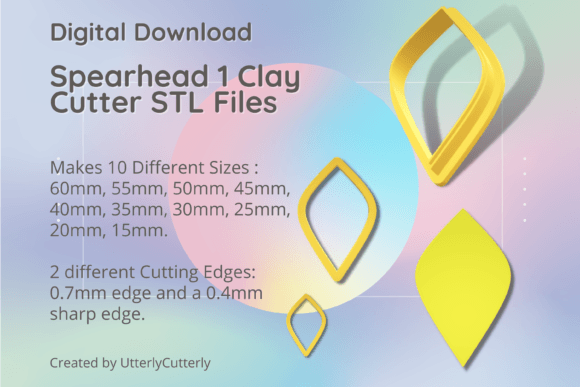
Makers must choose between durability and precision based on their specific material. The standard version features a 0.7mm wall with a 3mm thick base and 12mm height. This profile offers structural rigidity, making it suitable for stiffer clays or repetitive use where tool longevity is prioritized over razor-thin cuts. Conversely, the Sharp Edge variant, abbreviated as SE in the file names, utilizes a 1mm support wall tapering to a 0.4mm cutting edge. While maintaining the same 3mm base and 12mm height, the reduced contact surface area allows for cleaner slices through soft polymer clay or fondant with minimal drag.
Comparing these options reveals a necessary tradeoff. The 0.4mm SE edge produces superior detail but requires careful handling during printing and post-processing to avoid warping. The 0.7mm standard edge is more forgiving for beginners or those using entry-level FDM printers, though it may leave a slightly wider impression line. For professional jewelry components where clean edges reduce sanding time, the SE variant is typically the preferred choice despite its fragility.
Size Versatility and Scaling Considerations
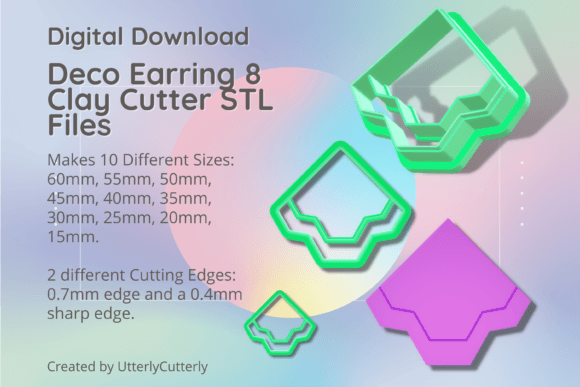
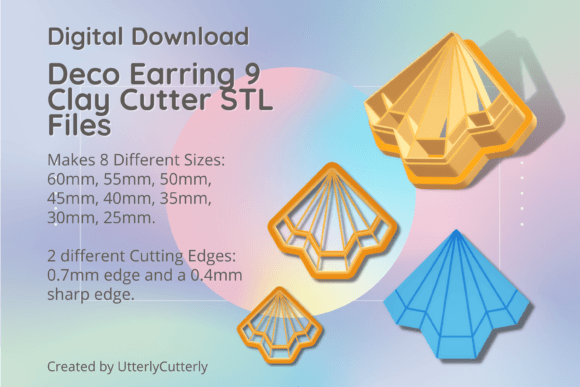
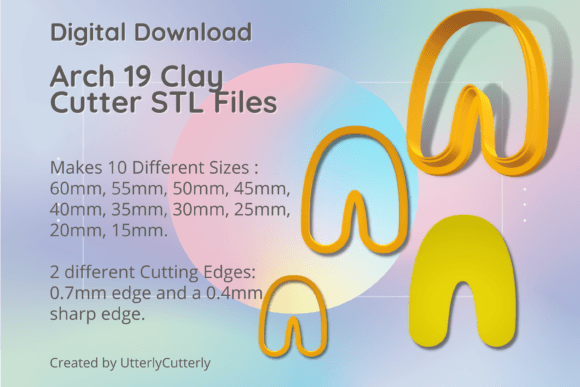
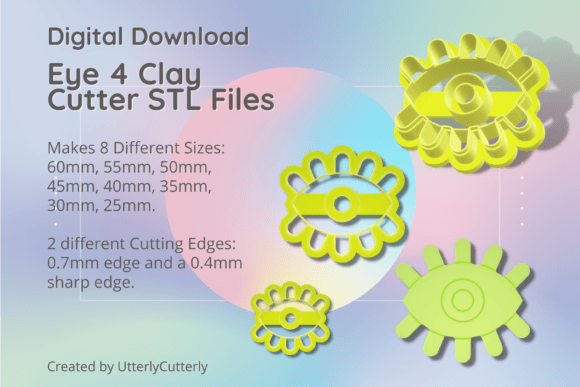
A significant advantage of the Spearhead 1 Clay Cutter STL digital file bundle over physical alternatives is the graduated sizing system. Physical cutter sets often have large gaps between sizes (e.g., jumping from 20mm to 30mm), forcing artists to compromise on design proportions. This digital pack includes ten incremental sizes: 60mm, 55mm, 50mm, 45mm, 40mm, 35mm, 30mm, 25mm, 20mm, and 15mm.
This granularity supports several practical workflows:
- Nesting Designs: Creating concentric spearhead patterns for earrings or pendants without manual measuring.
- Material Conservation: Selecting the exact size needed to minimize scrap clay or dough waste.
- Set Consistency: Producing matching jewelry sets (e.g., studs at 15mm and dangles at 40mm) with geometrically identical proportions.
It is important to note that cutter size is measured from the longest ends. Users accustomed to measuring width should verify dimensions against their project requirements before printing. Additionally, because these are vector-based STL files, intermediate sizes can be generated if the provided increments do not perfectly match a specific mold or bezel setting, offering flexibility that fixed physical tools cannot provide.
Embossing Compatibility and Material Thickness
For creators incorporating texture into their work, the embossing lines in this design are set at 10.5mm tall. This specification dictates a minimum material threshold; clay must be thicker than 1.5mm to accommodate the embosser without bottoming out or tearing. When comparing this to shallower cutters intended solely for outline cutting, the Spearhead 1 serves a dual purpose but imposes stricter material preparation requirements. If your standard workflow involves rolling clay to 1mm or less, this specific cutter geometry may not be compatible without adjusting your conditioning process.
Digital Files vs. Physical Cutters: Decision Factors
Choosing the Spearhead 1 digital download over a physical product involves evaluating immediate access against production effort. Digital files eliminate shipping times and allow for instant replacement if a tool breaks during a project. However, this convenience shifts the manufacturing burden to the user.
When Digital STL Files Are the Superior Choice
The Spearhead 1 Clay Cutter - STL Digital Fi is best suited for makers who:
- Own a Calibrated Printer: Achieving a functional 0.4mm cutting edge requires proper nozzle calibration, bed leveling, and cooling. Users with uncalibrated machines may struggle with the SE variants.
- Require Customization: The ability to mix and match sizes or modify files for personal use provides value beyond the initial purchase price.
- Produce High Volumes: Printing replacements costs pennies in filament compared to purchasing new physical cutters repeatedly.
- Value Iteration: New STL files are added to the store weekly, allowing collectors to build a cohesive library of compatible shapes over time.
When Physical Alternatives May Be Preferable
Despite the benefits of digital ownership, physical cutters remain relevant for certain users. If you lack 3D printing infrastructure, the time investment to learn slicing software and printer maintenance outweighs the cost savings of STL files. Furthermore, injection-molded steel or brass cutters offer edge sharpness and durability that FDM-printed PLA cannot match. For commercial bakeries or high-volume production environments where tool failure is not an option, traditional metal cutters may still be the industry standard. The Spearhead 1 digital files excel in prototyping, custom jewelry making, and small-batch artisanal work where uniqueness and adaptability take precedence over industrial-grade endurance.
Practical Implementation and Print Optimization
To maximize the utility of the Spearhead 1 bundle, users should approach printing with material-specific settings. The 3mm base provides adequate adhesion, but the thin walls of the SE variant benefit from specific slicer adjustments.
- Nozzle Selection: A 0.4mm nozzle is standard, but a 0.2mm nozzle significantly improves wall definition for the Sharp Edge variant.
- Cooling Management: Maximize part cooling fans to solidify thin layers instantly, preventing heat creep that blurs fine edges.
- Orientation Strategy: Always print cutters vertically with the cutting edge facing up. Printing flat results in layer lines along the cutting face, rendering the tool ineffective for clean cuts.
- Material Choice: PLA is sufficient for polymer clay, but PETG or ABS may be necessary for warm environments or dishwasher-safe cookie cutters. Note that higher temperature materials increase the risk of warping on thin 0.4mm edges.
All cutters in this bundle are tested prior to sale, ensuring the geometry is manifold and printable. However, "tested" assumes a properly tuned machine. Users experiencing issues should first verify their printer's dimensional accuracy and flow rate before assuming file defects. The distinction between the 0.7mm and 0.4mm versions also serves as a troubleshooting resource; if the SE version fails consistently, switching to the standard wall thickness often resolves structural printing issues while still providing a functional tool.
Integrating Into a Broader Digital Tool Library
The Spearhead 1 Clay Cutter - STL Digital Fi functions most effectively when viewed as part of an ecosystem rather than a standalone item. The consistent base height (12mm) and base thickness (3mm) across designs ensure uniform handling characteristics. When curating a custom cutter combo, maintaining these standardized dimensions reduces cognitive load during creative sessions. Makers can transition between different shapes without adjusting grip pressure or clay thickness expectations.
Furthermore, the digital format encourages experimentation. Unlike physical tools where each new shape represents a sunk cost, digital files allow users to test obscure sizes or variations with minimal financial risk. This low-barrier exploration often leads to unique design signatures that distinguish handmade goods in saturated markets. Whether creating architectural jewelry inspired by brutalist forms or intricate cookie sets for themed events, the precision and scalability of verified STL files provide a foundation for professional-grade craftsmanship accessible to hobbyists and small business owners alike.