Diamond 2 Clay Cutter - Donut Geometric: Evaluating Digital STL Files for Polymer Clay and Baking
The transition from purchasing physical tools to acquiring digital assets represents a significant shift in how makers approach polymer clay jewelry, cookie decorating, and fondant work. The Diamond 2 Clay Cutter - Donut Geometric serves as a prime example of this modern workflow, offering a bundle of geometric designs delivered as downloadable STL files rather than shipped plastic goods. For artisans aged 20 to 50 who are weighing the benefits of digital fabrication against traditional retail options, understanding the specific utility of this file pack is essential for making an informed investment.
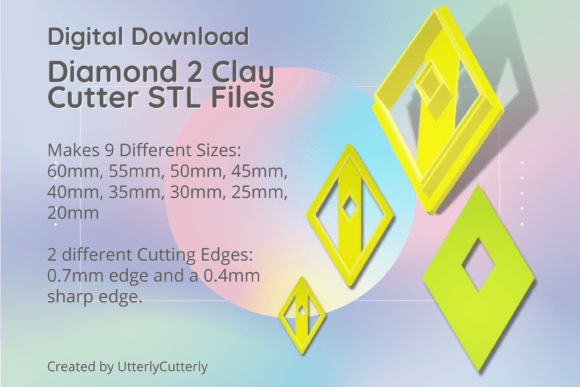
This digital collection distinguishes itself through technical specificity and versatility. Unlike generic cutter sets that may offer a single blade thickness or limited sizing, the Diamond 2 pack provides nine distinct sizes ranging from 20mm to 60mm and two specialized cutting edge profiles. This level of granularity allows users to curate custom toolsets tailored to specific projects, whether creating delicate earring components or substantial barrettes. However, the value of this product is entirely dependent on the user’s access to 3D printing hardware and their willingness to manage print settings. Evaluating this resource requires looking beyond the aesthetic appeal of the donut geometric shape to assess printability, material application, and long-term workflow integration.
Technical Specifications and Printability Assessment
When comparing digital cutter files, the geometry of the cutting edge is often the most critical differentiator between a successful print and a failed tool. The Diamond 2 Clay Cutter - Donut Geometric addresses this by offering two distinct cutter types within the same bundle, catering to different printer capabilities and material requirements.
- Standard Edge (0.7mm Wall): This version features a 0.7mm wall thickness with a 3mm base and 12mm height. It is designed for reliability and ease of printing. The thicker wall reduces the risk of layer separation during the print process and provides a sturdier tool that is less likely to warp when pressing into firm clay. This option is generally preferable for users with older FDM printers or those using standard PLA filaments where achieving ultra-fine details is challenging.
- Sharp Edge (SE): Abbreviated as SE in the file names, this variant utilizes a 1mm support wall tapering to a precise 0.4mm cutting edge. While it maintains the same 3mm base and 12mm height as the standard version, the reduced contact surface creates a cleaner slice through polymer clay and dough. This profile mimics the performance of high-end metal cutters but requires a well-calibrated printer capable of handling fine perimeters without clogging or under-extrusion.
Both cutter types include embossing lines set at 10.5mm tall. This specific dimension is a crucial technical constraint; it dictates that the clay must be conditioned to a thickness greater than 1.5mm to accommodate the embossing feature without bottoming out. Makers working with extremely thin veneers or translucent overlays may find this depth excessive, whereas those creating textured pendants or stamped cookies will appreciate the consistent impression depth.
Comparing Digital STL Bundles to Physical Retail Options
For creators accustomed to buying physical cutters, shifting to the Diamond 2 Clay Cutter - Donut Geometric involves trading immediate convenience for long-term flexibility. Physical cutters arrive ready to use, with guaranteed sharpness and structural integrity. In contrast, STL files require post-processing, including removal of supports, sanding of layer lines, and potential calibration adjustments.
However, the digital format offers advantages that physical products cannot match. The primary benefit is scalability. With nine sizes included in this single download, the cost-per-cutter drops significantly compared to purchasing individual physical tools. A maker can print a 25mm cutter for earrings and a 60mm version for coasters using the exact same geometric design language, ensuring visual consistency across a product line. Physical retailers rarely stock such comprehensive size gradations for niche geometric shapes due to inventory constraints.
Furthermore, digital files eliminate shipping delays and international tariffs. For makers who need a specific tool for a time-sensitive commission, the ability to download and print the Diamond 2 design locally removes logistical friction. The tradeoff is the requirement for technical proficiency. If a user lacks 3D printing experience or does not own a printer, the upfront cost of acquiring hardware or paying a third-party printing service may negate the savings of the digital file. In such cases, traditional retail remains the more practical choice despite the higher per-unit cost.
Material Compatibility and Application Fit
The versatility of the Diamond 2 Clay Cutter - Donut Geometric extends across multiple mediums, but performance varies based on material properties. Understanding these nuances helps determine if this specific STL pack aligns with your primary craft.
Polymer Clay Jewelry
This is the optimal use case for the Sharp Edge (SE) variant. Polymer clay responds well to thin blades, producing clean edges that require minimal sanding after baking. The geometric donut shape is particularly suited for modern earring trends, where negative space and angular precision are valued. The 0.4mm edge slices through conditioned clay without dragging, preserving the crispness of the diamond facets. Users should note that the 12mm height provides ample grip for pushing through thicker slabs, reducing hand fatigue during production runs.
Cookies and Fondant
While functional for baking, the application differs slightly. The Standard Edge (0.7mm) is often superior for food-safe applications because the thicker wall is easier to clean and sanitize; ultra-thin walls can trap flour or icing in layer gaps. The geometric nature of the donut design translates well to modern cookie aesthetics, though users should verify that their chosen filament is food-safe and rated for brief contact with edibles. The embossing feature works exceptionally well with fondant, providing defined texture that holds up during drying. However, for soft cookie dough, the intricate internal angles of the diamond shape may cause sticking, necessitating the use of release agents or chilling the dough prior to cutting.
Evaluating Size Selection and Design Versatility
A common limitation in both physical and digital cutter markets is the lack of intermediate sizing. Many packs jump from small to large without adequate graduation. The Diamond 2 Clay Cutter - Donut Geometric mitigates this by providing 5mm increments between 20mm and 60mm. This progression allows for deliberate design planning.
For example, a jeweler creating a graduated necklace can utilize the 30mm, 35mm, and 40mm cutters to create a balanced cascade effect. Similarly, a baker designing a tiered cake decoration can scale the motif appropriately for each tier without distorting the aspect ratio. When evaluating this pack against alternatives, consider whether the available sizes overlap with your existing inventory. If you already possess 30mm and 40mm geometric cutters, the unique value proposition of this bundle diminishes unless the specific diamond-donut hybrid aesthetic is required.
The modular nature of STL files also encourages cross-collection compatibility. Because these files are digital, they can be organized and paired with other geometric or organic shapes from the same creator’s weekly releases. This ecosystem approach allows makers to build a cohesive library over time, unlike physical collections which are often discontinued or inconsistently stocked.
Decision Factors: When to Choose Digital Over Physical
Selecting the Diamond 2 Clay Cutter - Donut Geometric is ultimately a decision about workflow preference and resource availability. This digital bundle is the right choice for makers who:
- Prioritize Customization: You need specific sizes or edge profiles that are unavailable in mass-produced tools.
- Own Reliable Hardware: You have a tuned 3D printer and are comfortable adjusting slicer settings for thin walls and embossing details.
- Value Iteration: You want the ability to reprint replacements instantly if a cutter breaks or wears down, rather than waiting for restocks.
- Work Across Scales: Your projects range from miniature jewelry to larger decorative items, requiring a unified design language across multiple dimensions.
Conversely, alternative options may be better suited if you require immediate usability without setup time, lack 3D printing infrastructure, or prefer the tactile certainty of injection-molded or metal tools. Additionally, makers working exclusively with very thin clay sheets (under 1.5mm) should carefully consider the embossing depth specifications, as this feature may not function as intended for their specific technique.
By weighing these technical specifications against personal workflow needs, artisans can determine whether the Diamond 2 Clay Cutter - Donut Geometric represents a valuable addition to their digital toolkit or if traditional resources remain the more efficient path for their current projects. The shift to digital assets is not merely about acquiring a new shape; it is about adopting a flexible, self-sufficient production model that rewards technical engagement with unmatched creative control.