Technical Specifications and Creative Applications of the 25mm Wide Rectangle 2 Clay Cutter - Geom STL Bundle
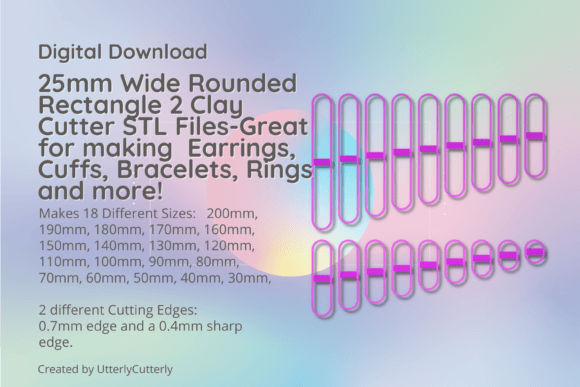
Achieving precision in polymer clay jewelry, ceramic design, and culinary arts often hinges on the quality of the tools used to shape raw materials. For makers utilizing 3D printing technology, the transition from digital design to physical object requires files optimized for both printability and functional performance. The 25mm Wide Rectangle 2 Clay Cutter - Geom digital download represents a specialized resource for creators seeking geometric consistency. This STL bundle provides a comprehensive suite of rectangular cutters designed specifically for producing earrings, cuffs, bracelets, rings, cookies, and fondant decorations. By offering eighteen distinct sizes and two unique cutting edge profiles, this digital asset allows users to curate custom toolsets tailored to specific project requirements without relying on generic, mass-produced alternatives.
Dual-Profile Engineering for Material Versatility
One of the primary advantages of this digital collection is the inclusion of two distinct cutter typologies within a single pack. Understanding the mechanical differences between these profiles is essential for selecting the right tool for specific substrates, whether that substrate is polymer clay, metal clay, cookie dough, or rolled fondant.
The Standard Wall Profile
The first profile features a 0.7mm wall thickness with a 3mm thick base and a total height of 12mm. This configuration prioritizes structural rigidity and durability. The 0.7mm wall offers a balance between sharpness and strength, making it suitable for firmer clays or repetitive use where thinner walls might deform over time. The robust 3mm base ensures that pressure applied during the cutting process is distributed evenly, reducing hand fatigue and preventing the top of the cutter from digging into the user's fingers. This profile is generally recommended for:
- Polymer Clay Conditioning: Cutting through well-conditioned but firm clay blocks.
- Ceramic Slabs: Slicing through leather-hard clay where resistance is higher.
- Dense Cookie Doughs: Shortbread or gingerbread doughs that require significant downward force.
- Educational Settings: Environments where tools may be subjected to heavier handling by students or beginners.
The Sharp Edge (SE) Profile
Abbreviated as "SE" in the file naming convention, the Sharp Edge variant utilizes a 1mm support wall tapering to a precise 0.4mm cutting edge. Like the standard profile, it maintains a 3mm thick base and 12mm height for ergonomic consistency. The reduced contact area at the cutting interface significantly lowers friction, allowing for cleaner slices with less distortion of the surrounding material. This geometry is critical when working with delicate mediums where dragging or tearing is a risk. Ideal applications include:
- Soft Polymer Clays: Translucent or soft blends that are prone to marring.
- Fondant and Gum Paste: Sugar work requiring crisp, professional edges without fraying.
- Intricate Jewelry Components: Small-scale rectangles where edge definition dictates the final aesthetic quality.
- Thin Metal Clays: Precious metal clay sheets where clean separation prevents waste.
Comprehensive Size Gradation and Dimensional Logic
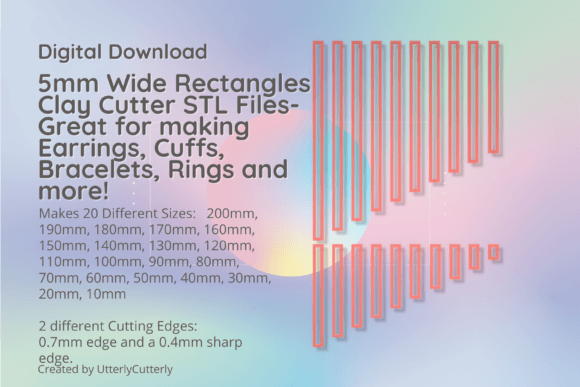
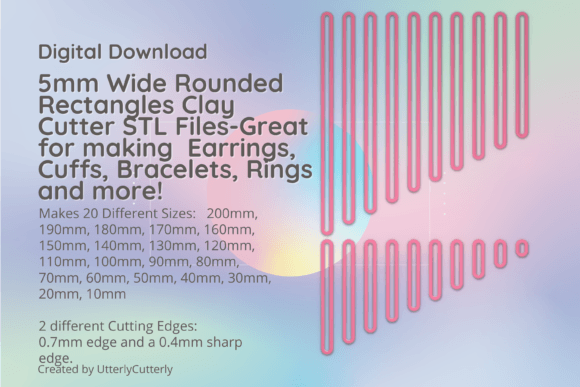
Design coherence in jewelry making and decorative arts often relies on proportional relationships rather than isolated dimensions. This STL bundle addresses this need by providing eighteen incremental sizes, measured from the longest ends of the rectangle. The available dimensions span from 30mm up to 200mm in consistent 10mm steps: 30mm, 40mm, 50mm, 60mm, 70mm, 80mm, 90mm, 100mm, 110mm, 120mm, 130mm, 140mm, 150mm, 160mm, 170mm, 180mm, 190mm, and 200mm.
This systematic gradation facilitates several advanced workflow strategies. Jewelry designers can create nested sets or graduated earring collections where each piece relates mathematically to the next. Bakers and confectioners can produce tiered fondant decorations or cookie assortments that maintain visual harmony. Furthermore, because the width remains constant at 25mm across all lengths, these cutters integrate seamlessly with other geometric STL files in the same ecosystem. Makers can combine these rectangles with circles, arches, or organic shapes of compatible scales to develop signature product lines that possess a unified visual language.
Embossing Integration and Clay Thickness Considerations
Beyond simple outline cutting, certain files in this bundle incorporate embossing lines to add surface texture and detail. These embossing features are engineered at a height of 10.5mm relative to the cutting edge. This specification carries important practical implications for material preparation.
For an embossing line to register clearly without bottoming out or creating uneven pressure, the clay slab must exceed the depth of the embossing feature. Consequently, users should prepare clay sheets thicker than 1.5mm when utilizing embossed variants. Working with thinner material risks incomplete impressions or structural weakness in the finished piece. This threshold serves as a reliable guideline for slab rolling and conditioning, ensuring that the decorative elements achieve their intended depth and clarity. When planning projects involving textured rectangles, verifying slab thickness with calipers before cutting can prevent material waste and rework.
Optimizing 3D Print Parameters for Functional Tools
While the 25mm Wide Rectangle 2 Clay Cutter - Geom files are designed for easy printing, achieving optimal functional performance requires appropriate slicer settings. The distinction between the 0.7mm wall and the 0.4mm SE edge demands different approaches to layer adhesion and perimeter generation.
For the standard 0.7mm wall profile, users should ensure sufficient perimeter shells to maintain wall integrity. A minimum of three to four perimeters is typically advisable, depending on nozzle diameter. Infill percentage is less critical than shell count for cutting tools, as the cutting force is borne primarily by the outer walls. However, adequate infill (20-30%) helps stabilize the 3mm base against warping during printing and provides internal support during use.
The Sharp Edge profile presents additional considerations due to its fine 0.4mm tip. Printing with a 0.4mm nozzle may result in a single extrusion width at the cutting edge, which can be fragile if layer adhesion is poor. Users may benefit from reducing layer height to 0.12mm or lower for the SE variants to improve resolution and interlayer bonding. Some slicers allow for variable line width settings; configuring a slightly wider external wall line can enhance durability without sacrificing edge sharpness. Regardless of profile, food-safe materials such as PETG or specific PLA variants should be selected for any cutter intended for culinary use, while standard PLA suffices for polymer clay and craft applications.
Workflow Integration Across Disciplines
The versatility of this rectangular cutter system extends beyond individual material types. Professionals and hobbyists operating across multiple disciplines can leverage these tools to streamline production and maintain brand consistency.
Jewelry Production: The 25mm width aligns with common earring back placements and bracelet link proportions. Designers can prototype rapidly by printing multiple sizes simultaneously, testing scale relationships on actual clay before committing to production runs. The ability to switch between standard and SE profiles allows optimization for different clay brands within the same studio.
Culinary Arts: Pastry chefs and cake decorators benefit from the precise dimensional control offered by 3D-printed cutters. Unlike adjustable hand-cut methods, these fixed-dimension tools guarantee uniformity across large batches. The embossed variants can create branded cookies or textured fondant panels that would be difficult to achieve consistently with traditional impression mats.
Educational and Research Contexts: In ceramics education or materials research, standardized cutting tools enable reproducible test specimens. Researchers evaluating clay shrinkage, drying behavior, or firing characteristics can produce identical samples using these cutters, eliminating geometric variability as a confounding factor. Educators can provide students with professionally proportioned tools that teach proper scale relationships and geometric construction principles.
Digital Asset Management and Future Expansion
Acquiring STL files represents an investment in a growing digital library rather than a static physical inventory. This bundle is part of an expanding catalog with new designs added weekly, enabling makers to build comprehensive tool collections over time. Organizing these digital assets systematically—by geometry type, size range, and edge profile—facilitates efficient retrieval during active projects.
Users should maintain clear documentation of which printer settings work best for each profile type, creating a personal reference that accelerates future production. As the store releases complementary geometries, the existing rectangle collection gains additional utility through cross-compatibility. This modular approach to tool acquisition allows creators to scale their capabilities incrementally, adding specialized cutters as project demands evolve rather than investing in large physical inventories that may never be fully utilized.
The intersection of digital fabrication and traditional craft techniques continues to expand possibilities for makers across skill levels and disciplines. Tools like the 25mm Wide Rectangle 2 Clay Cutter - Geom exemplify how thoughtfully engineered digital assets can bridge the gap between conceptual design and tangible creation. By understanding the technical specifications, material interactions, and workflow integrations outlined above, users can maximize the value of these resources and elevate the precision and professionalism of their handmade work. Whether producing delicate polymer clay earrings, architectural ceramic components, or artisanal baked goods, the right cutter transforms routine shaping into an exercise in controlled creativity.