Rectangle Clay Cutter: Basic Shape Geom STL Guide
Achieving crisp, consistent geometry in polymer clay, fondant, or cookie dough is often the difference between a homemade look and a professional finish. The Rectangle Clay Cutter - Basic Shape Geom digital collection addresses this specific need for precision. Rather than relying on freehand cutting or improvised tools that distort soft materials, this STL file bundle provides a standardized approach to creating rectangular forms. For makers, small business owners, and hobbyists utilizing 3D printing technology, having access to a comprehensive range of sizes ensures that your design assets remain versatile across multiple projects.
This digital download is not merely a single shape; it is a curated system designed for production and creative exploration. The visual personality of these cutters is defined by clean lines and mathematical accuracy. In an era where modern typography and minimalist brand identity dominate social media feeds, the ability to produce perfect geometric bases is essential. Whether you are crafting statement earrings, architectural pendants, or uniform baked goods, the Rectangle Clay Cutter - Basic Shape Geom serves as the foundational element upon which complex designs are built.
Technical Specifications and Print Optimization
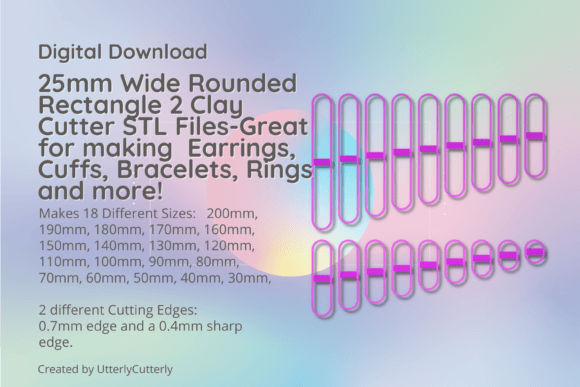
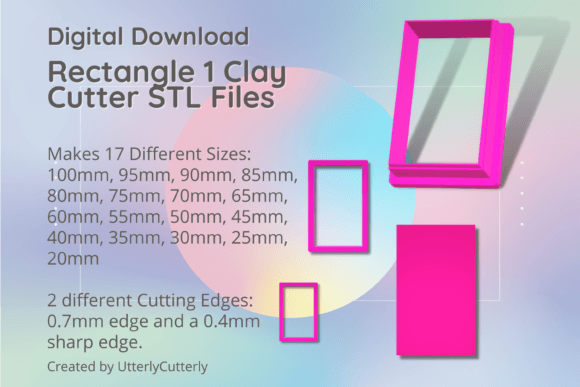
Understanding the technical parameters of your STL files is crucial for successful fabrication. This pack includes 17 distinct sizes ranging from 20mm to 100mm, measured from the longest ends. This granular sizing allows creators to curate custom combos easily, pairing a 45mm cutter for earring components with a 90mm version for pendant bases or cookie decorations. Such versatility mimics the flexibility found in premium font families, where multiple weights allow designers to establish clear visual hierarchy without breaking brand consistency.
The bundle offers two distinct cutter profiles, each engineered for specific material behaviors and aesthetic outcomes:
- Standard Edge (0.7mm Wall): Features a 0.7mm wall thickness with a 3mm thick base and a total height of 12mm. This robust profile is ideal for stiffer clays or when structural rigidity during the cutting process is paramount. The thicker wall reduces the risk of deformation when pressing into dense materials.
- Sharp Edge (SE): Abbreviated as SE in the file names, this variant features a 1mm support wall tapering to a precise 0.4mm cutting edge. Like a high-contrast serif font that adds elegance to editorial design, the Sharp Edge provides cleaner release and less drag on delicate polymer clay. It shares the same 3mm base and 12mm height specifications but prioritizes slice quality over wall mass.
For those incorporating texture, note that any embossing lines within the files are set at 10.5mm tall. This requires working with clay thicker than 1.5mm to ensure the impression registers clearly without compromising the structural integrity of the piece. This attention to dimensional detail reflects the same rigor applied to professional packaging design and logo design, where millimeter-level adjustments define usability.
Applications Across Creative and Commercial Projects
The utility of the Rectangle Clay Cutter - Basic Shape Geom extends far beyond simple jewelry making. Much like a versatile sans serif font that transitions seamlessly from web design to print collateral, these geometric cutters adapt to various mediums. For content creators and bloggers focusing on DIY crafts, consistent shapes translate to better photography and more cohesive social media graphics. Uniformity in physical products creates a recognizable visual signature, reinforcing brand perception and audience engagement.
In commercial baking and confectionery, consistency is a metric of quality. Fondant decorations and cookies cut with identical dimensions bake evenly and present professionally on display. The 100mm and 95mm sizes are particularly valuable for large-format treats or cake toppers, while the smaller 20mm to 30mm range supports intricate detailing work. Entrepreneurs can leverage this scalability to offer tiered product lines—using the same geometric language for both miniature charms and substantial home decor items.
Digital designers and marketers will also appreciate the crossover potential. Physical geometric shapes created with these cutters can be photographed and digitized to create custom textures, backgrounds, or icons for brand identity systems. The tangible nature of clay adds an organic warmth to digital layouts that pure vector graphics sometimes lack. By integrating handmade elements produced with precision tools, brands can balance modern aesthetics with artisanal authenticity.
Selecting the Right Profile for Your Material
Choosing between the Standard and Sharp Edge profiles should be driven by material science rather than preference alone. Evaluate your primary medium before printing. If you primarily work with soft, sticky polymer clay or marzipan, the Sharp Edge (SE) files reduce friction and prevent tearing. The 0.4mm cutting edge acts similarly to a sharp blade in traditional craftsmanship, ensuring the perimeter remains defined. Conversely, if you are cutting leather, stiff air-dry clay, or thick gingerbread dough, the 0.7mm Standard wall provides necessary leverage and durability.
Consider your post-processing workflow as well. Thicker walls may leave a slight ridge that requires smoothing, whereas sharp edges often produce a finish-ready edge straight off the printer. Testing font pairings in graphic design involves checking readability at different scales; similarly, test printing one size from each profile helps validate fit before committing to the full suite. This practical evaluation saves filament and time, ensuring your design assets perform as expected in real-world conditions.
Maximizing Value Through Digital Assets
As a digital download, this collection eliminates shipping delays and inventory costs, aligning with the agile workflows of modern creators. New STL files are added weekly, allowing your tool library to evolve alongside trending aesthetics. This continuous expansion mirrors how creative professionals update their font libraries to stay relevant in editorial design and marketing campaigns. Owning the source files means you have perpetual access to these tools, enabling rapid prototyping and iteration without recurring expenses.
When integrating these cutters into a commercial workflow, treat them as core infrastructure. Just as licensing a commercial font grants legal peace of mind and professional capability, acquiring specialized STL files legitimizes your production capacity. The Rectangle Clay Cutter - Basic Shape Geom pack provides the standardized geometry needed to elevate handmade goods into marketable products. By mastering these basic forms, you build a foundation that supports endless variation, ensuring your creative output remains both disciplined and distinctive.