Rounded Hexagon Clay Cutter STL: Basic Shape Guide
Achieving consistent, professional geometry in polymer clay, fondant, or cookie dough often requires more than a steady hand and a knife. The Rounded Hexagon Clay Cutter - Basic Shape digital collection addresses the specific need for precise, repeatable outlines that maintain structural integrity during handling and baking. By utilizing a downloadable STL file bundle, creators can bypass shipping delays and produce tools tailored to their exact project requirements immediately. This digital approach shifts the focus from acquiring physical inventory to mastering on-demand fabrication, allowing for greater flexibility in design workflows.
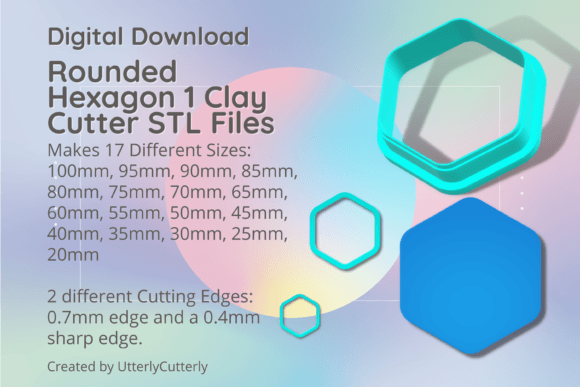
The rounded hexagon is a particularly versatile geometric form. Unlike sharp-edged polygons, the softened corners reduce stress points in baked goods and clay, minimizing cracking while retaining a modern aesthetic. For makers producing earrings, pendants, or barrettes, this shape offers an organic yet structured canvas for surface design. Having immediate access to seventeen distinct sizes ensures that you can create cohesive collections with proper scaling, rather than relying on mismatched tools that compromise visual harmony.
Selecting the Right Cutting Edge for Your Material
Not all cutting tasks require the same blade profile. This STL pack includes two distinct cutter variations designed to optimize results based on material viscosity and desired finish. Understanding the difference between these profiles is essential for preventing drag marks and ensuring clean releases.
The 0.7mm Standard Wall Profile
The standard version features a 0.7mm wall thickness with a 3mm thick base and a total height of 12mm. This robust profile provides significant rigidity, making it ideal for denser materials like cold porcelain, stiff polymer clay, or rolled fondant. The wider wall acts as a stabilizer, preventing the cutter from flexing when pressure is applied. This stability is crucial when working with thicker slabs where a thinner blade might bend or warp, resulting in distorted shapes. Use this profile when durability and ease of handling are prioritized over microscopic edge precision.
The Sharp Edge (SE) Profile
Abbreviated as SE in the file names, the Sharp Edge variant utilizes a 1mm support wall tapering to a fine 0.4mm cutting edge. Like the standard version, it maintains a 3mm thick base and 12mm height for grip and strength. This reduced cutting surface area significantly decreases friction against sticky materials. It is the superior choice for soft polymer clays, gum paste, or delicate cookie doughs where dragging is a primary concern. The sharper edge slices through material cleanly rather than compressing it, preserving intricate details and reducing the need for post-cut trimming. However, users should note that the finer edge requires careful handling during printing and cleaning to avoid damage.
Comprehensive Sizing for Scalable Design Systems
One of the most significant advantages of this digital bundle is the granular size progression. Physical cutter sets often skip sizes to reduce manufacturing costs, leaving gaps in a maker's toolkit. This STL set covers a continuous range measured from the longest ends: 100mm, 95mm, 90mm, 85mm, 80mm, 75mm, 70mm, 65mm, 60mm, 55mm, 50mm, 45mm, 40mm, 35mm, 30mm, 25mm, and 20mm.
This 5mm increment system supports several practical applications:
- Nesting and Layering: Create multi-dimensional jewelry or decorative elements by stacking progressively smaller hexagons. The consistent spacing allows for uniform borders without manual measuring.
- Product Line Consistency: Small business owners can offer identical designs in multiple scale options (e.g., stud earrings at 20mm and statement pendants at 60mm) using mathematically related proportions.
- Waste Reduction: Select the exact size needed for your slab dimensions to maximize yield, particularly important when working with expensive precious metal clays or specialty edibles.
Because these files are digital, you can curate custom combinations alongside other STL assets in your library. If a project calls for a non-standard intermediate size, you can easily scale the model in your slicer software, though printing at native resolution is recommended for optimal layer adhesion.
Technical Considerations for Embossing and Print Quality
For creators incorporating texture into their work, understanding the Z-axis limitations of these cutters is vital. Any embossing lines included in the design stand 10.5mm tall. Given the total cutter height of 12mm, this leaves only 1.5mm of clearance above the embossed feature.
Critical Usage Note: You must work with clay or dough thicker than 1.5mm when using embossed variants. If your material is thinner than this threshold, the top rim of the cutter will contact your work surface before the embossing detail fully registers, potentially damaging both the print and your rolling mat. Always measure your slab thickness with calipers before selecting an embossed cutter.
When printing these files, orientation matters. Print the cutters with the cutting edge facing up to avoid the need for supports on the functional surface. A 3mm brim is generally sufficient given the wide base, but ensure your first layer calibration is precise; any irregularities on the bottom layer will translate directly to the cutting edge. PLA is typically sufficient for clay and cookies, but PETG may be preferable for food-safe applications due to its higher temperature resistance and lower moisture absorption, provided your printer is properly tuned for the material.
Who Benefits Most from Digital Cutter Files?
While anyone with a 3D printer can utilize these files, specific user groups derive disproportionate value from this format. Professional jewelry makers benefit from the ability to replace worn tools instantly without supply chain delays. Educators and workshop leaders can print dozens of identical cutters for students at a fraction of retail cost. Home bakers and hobbyists gain access to industrial-grade sizing variety that would be prohibitively expensive to purchase physically. Freelance designers appreciate the portability; the entire toolkit exists as data, taking up zero shelf space until needed.
However, this format does have limitations. It requires access to a functioning 3D printer and basic slicing knowledge. Those without printing capabilities or who prefer the tactile assurance of injection-molded steel may find physical alternatives more suitable. Additionally, while 3D printed plastic is excellent for clay and fondant, it is not appropriate for high-temperature culinary environments beyond standard baking temperatures, nor is it dishwasher safe. Users must weigh these operational constraints against the benefits of customization and immediacy.
Maximizing Workflow Efficiency with Digital Assets
Integrating the Rounded Hexagon Clay Cutter - Basic Shape STL files into your production process represents a shift toward agile making. Rather than waiting for tools to arrive, you can iterate on designs in real-time. Test a 45mm cutter for a new earring line, evaluate the result, and print a 50mm version within hours if adjustments are needed. This rapid feedback loop accelerates product development and reduces the stagnation that occurs when waiting for external suppliers.
Furthermore, digital files allow for archival organization. Instead of managing bulky physical storage, you maintain a searchable library of geometries. New STL files added to the store weekly can be integrated seamlessly with this basic shape pack, enabling complex composite designs that combine hexagonal bases with specialized textures or cutouts. By treating cutters as modular digital components rather than static physical objects, you unlock a level of creative efficiency that traditional tooling simply cannot match.
Ultimately, the value of this bundle lies in its adaptability. Whether you are refining a signature jewelry style, streamlining cookie production, or exploring new textural possibilities in clay, having precise control over your cutting tools removes technical barriers. The rounded hexagon serves as a foundational element upon which countless variations can be built, and having seventeen sizes across two edge profiles ensures that your tools serve your vision, not the other way around.